
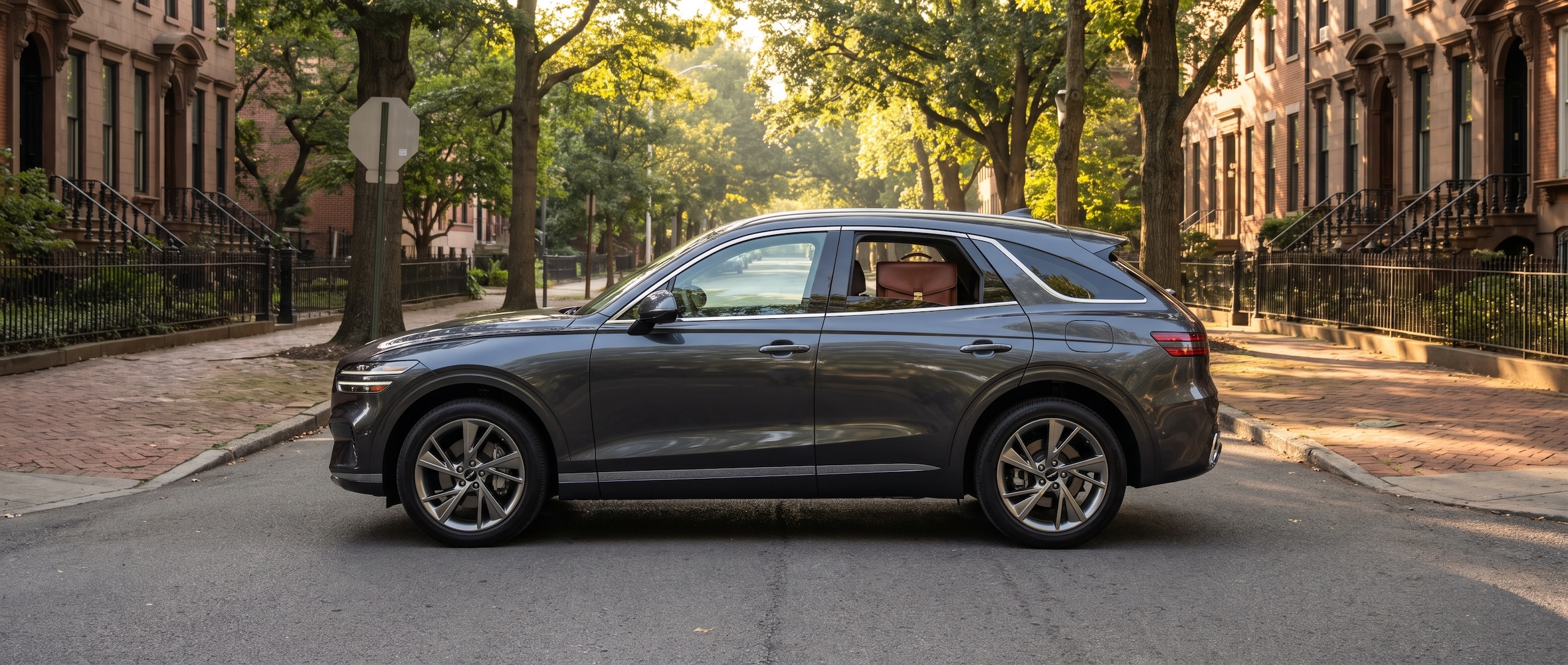
Vanderbilt's campus sits about six miles from our showroom on Bell Road. The distance is short. Deciding which car to drive it in isn't.
When Vanderbilt faculty and staff come through, the conversation tends to run a familiar course. Someone cross-shopped European luxury, found Genesis on the list, and now needs to sort out which of four genuinely different vehicles fits their life. The G70, G80, GV70, and GV80 share a design language and a badge, but they answer different questions. Getting that match right is the whole job of this guide.
What You Need Before You Start
Before you set one model against another, it's worth mapping how you actually use a car, because three real dimensions separate faculty and staff buyers more than any spec sheet ever will. Get those clear and the rest falls into place.
| Dimension | Factors to Consider |
|---|---|
| Daily seating | Solo commuter vs. carries grad students, colleagues, or family regularly |
| Parking context | Vanderbilt garage or surface lot; note column clearance and stall width |
| Trip character | Local campus hops vs. longer interstate runs (I-65 to Franklin, conference travel) |
| Cargo needs | Laptop bag only vs. research equipment, instruments, or family gear |
| Engine preference | Efficiency vs. reserved power for weekend driving |
That grid won't hand you an answer yet. The steps below use it to steer you toward one of four models.
Matching the Right Genesis to Your Campus Profile
Matching the right Genesis to your campus profile comes down to a handful of plain questions about who rides with you, where you park, how you want the drive to feel, and what you carry, and answering them in order narrows four very different vehicles down to one before you ever discuss a trim. Work through it honestly.
Step 1: Settle the rear-seat question first
Start here, because the rear seat is the variable that quietly removes two models for some buyers and opens all four for others, and it decides more than any single option box on the order form.
If you seat another adult in back with any regularity (a grad student riding to a conference, a partner on weekend trips, a colleague splitting the drive), the G80 and GV80 deserve the first look. The 2026 G80 gives you 38.7 inches of rear legroom in a cabin tuned for quiet, composed travel. The GV80 matches that comfort in a taller body, with available third-row seating if your household ever needs it.
If you're solo 90 percent of the time and a back-seat rider is genuinely occasional, the G70 and GV70 stay in play. Neither feels cramped up front. The rear seats work for shorter trips and make no secret of their limits.
Step 2: Audit your parking situation
Vanderbilt's structured parking runs tight, and footprint is where two of these models pull ahead of the others in daily use. Sony Garage, Terrace Place, and West Garage give you standard stalls with columns close to the driver's side in the older structures.
The G70 and GV70 handle these cleanly. At 185.6 inches bumper to bumper, the GV70 tucks in without drama. The G80 stretches to 196.5 inches and the GV80 to 194.5 inches, and that extra foot matters in a garage where you're also juggling a bag, a laptop, and a 7:50 lecture. If you've ever had to breathe in to squeeze past a column, the compact footprint of the GV70 or G70 stops being a minor point.
The GV70 also offers Remote Smart Parking Assist on select trims, which maneuvers the vehicle into and out of tight spaces while you stand outside it. In a garage where the pull-through spaces vanish by 8 a.m., that's a real convenience.
Step 3: Consider the drive character, not just the spec sheet
Drive character is where the G70 earns serious attention from the right buyer, since it's the driver's car in the Genesis lineup, with standard Brembo performance brakes, rear-wheel drive available, and a 2.5-liter turbo-four producing 300 horsepower in AWD configuration that the EPA rates at 21 city and 29 highway in RWD trim. The drive from Nashville south toward Brentwood, or west on Highway 100 toward the Natchez Trace, feels connected in a way a larger sedan doesn't.
The tradeoff is plain. The G70's trunk holds 10.5 cubic feet, enough for a briefcase, a laptop bag, and one carry-on. It won't cover a full conference weekend plus airport pickup duty. Know that before you fall for the driving character.
The G80 runs the opposite calculus. Its 2.5-liter turbo-four produces 300 horsepower and 311 lb-ft of torque, yet Genesis tuned the G80 for linear smoothness over urgency. The 13.1-cubic-foot trunk is modest for a midsize sedan, but the cabin absorbs a long stretch of I-65 in a way that leaves you less fatigued at the far end. The 2026 G80 carries a five-star overall safety rating from NHTSA, and Highway Driving Assist II makes long drives noticeably calmer.
Step 4: Weigh cargo honestly if you carry gear
Academics and researchers tend to carry more than they admit when they're spec'ing a car, so be candid here. The GV70's 56.9 cubic feet of maximum cargo (rear seats folded) covers most scenarios. Fold the GV80's seats and it expands to 84 cubic feet. If you haul equipment, instruments, or anything that needs real loading depth, that gap matters. If you're just moving between buildings with a laptop and a tote, neither SUV will feel underused.
- [ ] Identify your most frequent use: solo commute or regular rear passenger?
- [ ] Note the parking structure you use most and whether length is ever a constraint
- [ ] Decide whether you want the drive to feel engaged or composed and quiet
- [ ] Tally your realistic cargo: laptop bag only, or gear that needs real volume?
- [ ] Confirm which engine character suits your longest regular trip
Step 5: Run the model grid
| Model | Best for | Tradeoff worth knowing |
|---|---|---|
| G70 | Solo driver, wants a connected, driver-focused feel, compact footprint | 10.5 cu ft trunk limits multi-day trips; rear seat tight for adults |
| G80 | Faculty who value composed cabin, regular rear passengers, longer interstate legs | 13.1 cu ft trunk modest; longer body in tight garages |
| GV70 | Versatile all-rounder: SUV practicality, compact footprint, engaging handling | 56.9 cu ft max cargo; EPA-estimated 20 city / 28 highway mpg |
| GV80 | Families or frequent passenger carriers; maximum cabin space and available third row | Larger footprint; 194.5 inches may tighten in constrained garages |
Step 6: Factor in the ownership pattern, not just the purchase
Ownership pattern belongs in this decision too, because Genesis's ownership model includes at-home concierge service and scheduled maintenance pickup in general terms we're comfortable confirming, and for a faculty member whose schedule doesn't flex easily around a service appointment, that convenience carries real weight. Service logistics matter here. They're not an afterthought.
If your schedule is genuinely unpredictable (semesters that compress around grant deadlines, conference seasons that disappear for weeks), a model you can hand off without losing a half-day of productivity is worth weighing right alongside the seat configuration.
A Print-and-Go Recap Before You Visit
Run through this list before you visit, because three quiet minutes spent answering it at your kitchen table will make the conversation on our lot far more useful, and it keeps the visit pointed at the two or three models that actually fit rather than a slow walk past all four. It takes almost no time.
- [ ] Rear seat: do I regularly carry adults more than once a week?
- [ ] Parking: is my primary structure tighter than a typical surface lot?
- [ ] Drive character: do I want engaged and responsive, or composed and quiet?
- [ ] Cargo: what's the largest single load I carry at least monthly?
- [ ] Trip length: are most drives under 20 minutes, or do I do longer interstate runs regularly?
- [ ] Ownership logistics: does at-home service pickup change the equation for me?
If rear passengers and cargo matter, look at the GV80 or G80. If you want the SUV footprint with a compact, agile feel, reach for the GV70. And if the drive itself is part of why you enjoy the commute, the G70 works, provided the trunk suits you.
Bring that shortlist to us. We'll put you in the seat that actually fits.
Frequently Asked Questions
Which Genesis model fits best in Vanderbilt's parking garages?
The G70 and GV70 offer the most manageable footprints for structured garage parking. The G70 measures 184.5 inches in length and the GV70 stretches to 185.6 inches, compared to 196.5 inches for the G80 and 194.5 inches for the GV80. In garages with tight stall widths and close columns (a common feature of older campus structures), that difference is tangible on a daily basis. The 2026 GV70 also offers Remote Smart Parking Assist on select trims, which can maneuver the vehicle into a space while you stand outside it.
Is the G80 or GV70 better for a faculty member who occasionally travels to conferences?
It depends on how you travel. If you typically fly and use the car primarily for local commuting, the GV70's 56.9 cubic feet of maximum cargo covers conference prep comfortably. If you drive to conferences and need sustained comfort on long interstate stretches, the G80's composed cabin and rear legroom of 38.7 inches make it the stronger choice for multi-hour drives. The G80 carries a five-star overall NHTSA safety rating and Highway Driving Assist II, which reduces driver fatigue on longer runs.
