
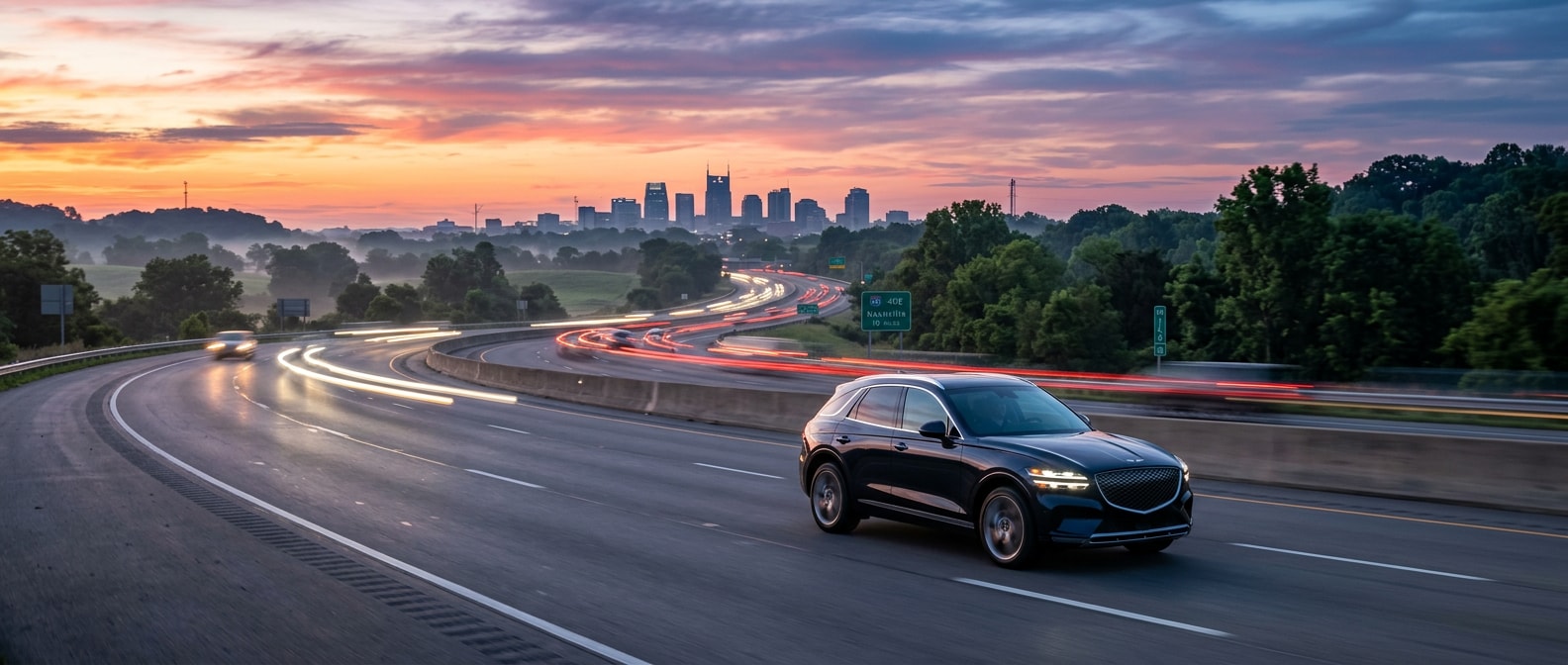
The Smyrna-to-Nashville run on I-24 covers 24 miles each way. On a clear Tuesday at 6:45 a.m., you'll do it in under 30 minutes. On a Thursday when the Antioch interchange decides to fail everyone at once, you might sit for an hour. That range (and the specific character of this corridor) is what should decide which 2026 Genesis GV70 you're sitting in.
We've spent time with this car and watched how Middle Tennessee drivers use it. The GV70 trim decision has less to do with prestige than with matching powertrain, efficiency, and cabin technology to the way this corridor runs.
- The 2.5T AWD is the precision pick for the Smyrna commuter: the EPA rates it at 28 mpg highway, and the I-24 corridor is highway-weighted enough that this number matters daily.
- The 3.5T AWD brings 375 horsepower and standard adaptive suspension, but its 18 mpg city rating bites on days when the Antioch merge backs traffic to La Vergne.
- Every 2026 GV70 trim includes adaptive cruise with stop-and-go. On I-24 this is no luxury add-on; it's the feature you'll use most.
- The 27-inch OLED cabin display and 3-zone climate control are standard across the lineup as of 2026; you don't have to buy up to get them.
- Both engines require premium fuel. Factor that in before you decide whether the 3.5T's power justifies the efficiency trade.
Browse our current GV70 inventory to see which trims and configurations are available right now.
What Actually Matters When You're Choosing a GV70 Trim for This Drive?
What matters most here is how the corridor splits your driving into two modes, one of them genuine highway cruising where the GV70 runs efficiently, the other stop-and-go near the interchange where cabin composure and driver assistance carry more weight than horsepower. The I-24 stretch between Smyrna and Nashville has a character all its own. It runs predominantly interstate, with a concentrated compression point where traffic from Murfreesboro merges through La Vergne and into the Antioch area before the city opens up. That pattern rewards different trims at different moments.
Below is how the 2026 GV70's two main powertrain choices stack up against what this commute demands.
| Option | Best For | Key Spec | Tradeoff |
|---|---|---|---|
| 2.5T AWD (2.5L turbo four-cylinder) | Highway-weighted Smyrna commuter who runs the I-24 corridor most days | EPA 20 city / 28 hwy mpg; 300 hp / 311 lb-ft torque | City mpg dips in heavy Antioch traffic; lighter feel at highway merge speeds |
| 3.5T AWD (3.5L twin-turbo V6) | Driver who values effortless power, carries the car into weekends, or logs heavier stop-and-go mileage | EPA 18 city / 25 hwy mpg; 375 hp / 391 lb-ft torque; standard adaptive suspension | Lower city efficiency; requires premium fuel; higher acquisition cost |
| Electrified GV70 AWD | Driver who charges at home and wants zero-fuel commuting on a short daily cycle | EPA-estimated range (verify current figures with our team); 429 hp | Charging infrastructure planning required; higher entry point |
Both gasoline engines pair with an 8-speed automatic and standard AWD for 2026. Neither leaves you short on traction on an icy January morning on I-24.
The Efficiency Gap Is Real and the Smyrna Run Exposes It
The efficiency gap between the two engines looks small on paper and adds up over a week, with the EPA rating the 2026 GV70 2.5T AWD at 20 mpg city and 28 mpg highway and the 3.5T AWD at 18 mpg city and 25 mpg highway, both on premium unleaded. Most GV70 write-ups skip this part because it isn't exciting. We'll be direct.
On a clean, free-flowing I-24 morning, the 2.5T's 28-mpg highway figure does real work across 24 miles. The 3.5T's highway number stays competitive, and 25 mpg is no penalty, but the city figure is where the difference stacks up across a full week of commuting, on the mornings when the Antioch interchange compresses everything to a crawl. Both engines drink premium fuel, and no trim changes that.
Explore financing options if you're mapping the total ownership picture, or compare the GV80 if you're considering stepping up in size.
The 2.5T's 300 horsepower and 311 lb-ft of torque are plenty for this drive. Merging onto I-24 from the Smyrna entrance ramps happens without drama. The 3.5T's 375 horsepower feels more effortless at higher speeds, on uphill grades, and when you want a decisive pass. Call that the tradeoff, stated plainly.
Pros and cons for the Smyrna commuter
| Pros | Cons |
|---|---|
| 28 mpg highway EPA on the 2.5T, genuine daily fuel savings on a highway-weighted route | Both engines require premium fuel, which narrows the cost advantage versus non-premium competitors |
| Adaptive cruise with stop-and-go standard on all 2026 trims, immediately useful in Antioch backup | 3.5T city efficiency (18 mpg) is noticeably lower on high-congestion mornings |
| 27-inch OLED display standard for 2026, reduces time looking down for nav or audio adjustments | The GV70's rear seat is compact (fine for solo commuting, less so for regular adult passengers behind a tall driver) |
| Standard AWD on all configurations for 2026, no drivetrain upcharge to worry about | No mild hybrid option on gasoline trims, unlike some segment competitors |
| Adaptive suspension on the 3.5T, visibly better on Tennessee's rough interstate surface patches | 3.5T carries a meaningful price premium for features a solo commuter may not fully use |
Match the GV70 to How You Actually Drive This Route
Matching the GV70 to your route starts with an honest look at what the car does most, and the I-24 Smyrna run is a 24-mile, predominantly highway trip, so if you're on it five days a week and that is the car's primary purpose, the 2.5T AWD is the trim that makes the most direct sense. The efficiency is useful, the power suits this corridor, and the cabin technology you'll engage every morning (the stop-and-go adaptive cruise and the 27-inch OLED especially) is standard across the lineup.
On the lot, the detail that surprises taller drivers is the rear seat behind their own seating position; it's roomy enough solo, tighter with an adult back there.
If the GV70 doubles as your weekend car, your airport run car, or you simply want the 3.5T's additional composure at higher speeds and the standard adaptive suspension that smooths the rougher patches between Smyrna and La Vergne, the calculus changes. For a commuter the 3.5T is a considered choice with a real fuel trade rather than an extravagance.
The Genesis G80 is worth a look if your commute runs mostly highway and rear-seat comfort for occasional passengers matters, a different proposition we're happy to walk through in person.
One thing no trim choice changes: every 2026 GV70 includes blind-spot monitoring, rear cross-traffic alert, forward collision avoidance with automatic emergency steering, and lane-centering assist. TDOT completed Phase 2 of the I-24 SMART Corridor in January 2025, so overhead sensors and variable message signs now feed real-time routing information on this exact stretch. The GV70's standard safety suite works alongside that infrastructure to add another layer.
If you're replacing a daily driver and want a sense of what your current vehicle is worth before stepping into a GV70, that's a straightforward place to start. And if you'd like to drive the 2.5T and 3.5T back to back, with the commute questions front and center, our team at Genesis of South Nashville sits at 1635 Bell Rd, a practical 20 minutes from Smyrna via I-24.
Frequently Asked Questions
Is the 2026 Genesis GV70 2.5T powerful enough for I-24 highway merging from Smyrna?
Yes. The 2026 GV70 2.5T AWD produces 300 horsepower and 311 lb-ft of torque through an 8-speed automatic, which Genesis rates for a 0-60 time of approximately 6.1 seconds. I-24 entrance ramps from the Smyrna area are standard highway geometry. The 2.5T handles them without effort. The 3.5T's 375 horsepower and 5.1-second 0-60 are genuinely quicker, and the 2.5T remains well-suited to this corridor. If your concern is the merge itself, the trim choice is not the limiting factor.
Does the 2026 GV70 have stop-and-go adaptive cruise control standard, or is it a higher-trim feature?
Stop-and-go adaptive cruise is part of the GV70's standard safety and driver-assist suite across the 2026 lineup. You don't need to step up to a higher trim to get it. For a commute that includes the Antioch interchange on I-24, where traffic can compress without warning, this is the feature our team consistently points to first. It earns that spot for a simple reason: it's the one you'll actually use on Tuesday morning when the corridor backs up past La Vergne.
