
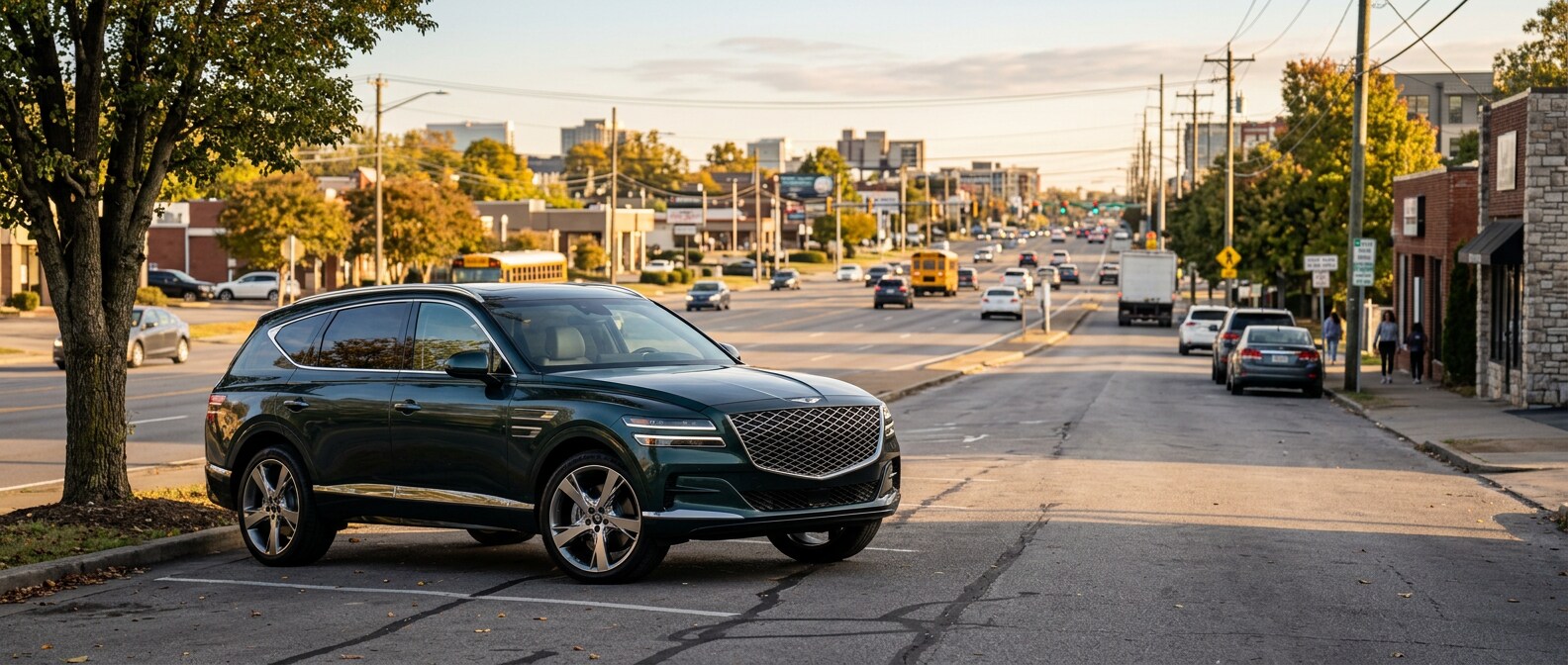
Drive Nolensville Pike with kids aboard and you already know the corridor plays differently in 2026. It handles roughly 40,000 vehicles per day. TDOT is actively widening it from two lanes to five between Burkitt Road and Old Hickory Boulevard, with dedicated turn lanes and sidewalk additions under construction. What you get from all that is compressed lanes, unpredictable merge points, and the crawling school-run traffic that tests a driver's patience and a vehicle's driver-assistance suite in equal measure. The commute isn't comfortable. The car you choose matters.
We carry both the Genesis GV70 and the Genesis GV80 on our lot, and parents weigh which one makes more sense for their situation. The straight answer is that they solve different problems. Our pick for families who need third-row access, or the kind of rear-seat space that makes a long pickup-line wait bearable, is the GV80. The GV70 fits better if your household runs one or two children and you want something that rewards careful driving through tight construction zones without feeling like you're piloting a full-size SUV. Below is how we break it down.
How We Ranked These Two
| Rank | Pick | Best For | Standout Spec |
|---|---|---|---|
| 1 | GV80 | Families needing third-row capacity or wide rear bench | Up to 38.7 cu ft cargo (2-row), 7-passenger option; NHTSA 5-Star + IIHS TSP+ |
| 2 | GV70 | One-to-two-child families wanting composure in tight stop-and-go | 28.9 cu ft cargo, 300 hp 2.5T, NHTSA 5-Star + IIHS TSP+; smaller footprint through construction lanes |
We ranked by family capacity first and then by fit for this specific corridor, since both cars clear the same bar on refinement and safety, and the deciding factor becomes how much rear space you actually need against how much SUV footprint you want to thread through active construction. Neither vehicle asks you to compromise. What differs is only which of those two pressures rules your household.
GV80 - When Headcount or Rear-Seat Comfort Comes First
The GV80 takes the top slot whenever headcount or rear-seat comfort leads your decision, which covers three kids, a carpool rotation, or a rear bench that has to seat two adults beside a child seat, and that capacity is where the GV80 answers a problem the smaller GV70 simply can't reach.
The 2026 GV80 offers five- or seven-passenger seating depending on trim. Two-row models deliver 38.7 cubic feet of cargo space behind the second row, while three-row configurations give 11.6 cubic feet behind the third row. That last number is the one to sit with. Eleven-point-six cubic feet behind the third row is real but modest, enough for a stroller if you configure it carefully, not enough to make it effortless. Run a three-row GV80 with the third seat up and you're choosing passenger capacity over cargo access, a fine trade for the right family. Just go in clear-eyed.
The 2026 GV80 offers two engine choices, a 300-horsepower 2.5-liter turbocharged inline-four and a 375-horsepower 3.5-liter twin-turbo V6. On Nolensville Pike's current construction stretch, you're rarely near either engine's upper range. What you lean on constantly is the driver-assistance stack. The GV80's safety suite includes Lane Following Assist, Forward Collision-Avoidance Assist, and Safe Exit Assist, which prevents passengers from opening doors into approaching traffic. Worth naming that last feature on its own. In a condensed construction lane, with bikes and pedestrians being added to the corridor, a door-opening alert earns its keep, an engineering decision that matters when a child sits in the rear seat.
The 2026 GV80 holds a 5-Star Overall Safety Rating from NHTSA. It also earned the IIHS Top Safety Pick+ for 2026. Both are the highest marks each organization awards.
The honest tradeoff is size. A large vehicle threads a corridor that, for now, runs tighter than its designed width suggests, and you feel it. Parking at school pickup and steering around lane-shift cones takes more attention than the GV70 asks. Not a disqualifier. Just the reality of driving a midsize SUV through an active construction zone.
View Current GV80 Availability
GV70 - The Composed Choice for Tighter Situations
The GV70 isn't a consolation prize, it's the sharper tool for this exact corridor, and for a one- or two-child household it may be the smarter buy of the pair because its footprint and composure suit tight construction lanes better than the larger GV80 does. We'll be direct about that.
The GV70's strength on Nolensville Pike is precision. Its smaller body threads narrower construction-zone lanes, and a tighter turning radius makes school-loop maneuvers less stressful. Behind the rear seats, the GV70 offers 28.9 cubic feet of luggage space, expanding to 56.9 cubic feet with the rear seats folded. For a family running one or two children, that's a practical daily-driver cargo area. Two child seats fit without crowding the center position, and a folded stroller and a week's grocery run load without a game of cargo Tetris, at least on the ordinary run.
The GV70 offers a 2.5-liter turbocharged inline-four with 300 horsepower and 311 lb-ft of torque, or a 3.5-liter twin-turbo V6 producing 375 horsepower and 391 lb-ft. On a corridor where you spend much of your time between 15 and 35 miles per hour, the 2.5T is the right engine for this use case. The EPA rates the 2026 GV70's 2.5T at up to 20 city and 28 highway MPG. That highway figure matters more for families running errands between South Nashville and Brentwood or Thompson's Station, where the drive opens up. The in-town number tells you more about the Pike itself.
Check the LATCH anchors yourself before you sign anything. On our lot, the GV70's rear door opens wide enough that a rear-facing seat drops in without you kneeling on the sill, a small thing until you've done it twice a day in a work coat.
NHTSA awarded the 2026 GV70 a 5-Star Overall Safety Rating. Standard safety technology includes Forward Collision-Avoidance Assist, Lane Keeping Assist, Blind-Spot Collision-Avoidance Assist, and Rear Cross-Traffic Collision-Avoidance Assist. The IIHS also awarded it Top Safety Pick+ for 2026, and rated its LATCH ease of use as "Good," which is the top rating in that category. If you're installing and uninstalling child seats regularly, that matters in the real world.
The tradeoff here is straightforward. If your family grows, or if you regularly carry more than four people, the GV70's two-row, five-seat layout is a ceiling. You can't option a third row, and that's the one genuine limitation worth knowing before you fall in love with the interior.
Our Take: Matching the Right GV to Your Real Pickup-Line Situation
Our take is simple to state and harder to live with, match the GV to your real pickup-line situation, because Traffic on Nolensville Pike is expected to nearly double over the next 20 years, per TDOT projections, and the car that fits today's construction may not be the car that fits the corridor's future. Construction is a temporary condition. Its growth trajectory is permanent. Pick the vehicle that works for the road as it becomes, not just as it is today.
For families running two children or fewer, where five seats is enough, the GV70 is the vehicle we'd suggest considering first. The composed handling, the smaller footprint through active construction, and the more maneuverable daily-driver character make it well-suited to this specific commute pattern. You give up third-row optionality and a few inches of cargo depth compared to the two-row GV80. You gain a vehicle that feels confident and unhurried in stop-and-go conditions.
For families where headcount matters, where the GV80's rear bench depth or third-row option resolves a real problem, the GV80 is worth the tradeoffs. Just go in knowing the construction-zone experience will take more attention, and that the three-row cargo floor is modest. Both vehicles carry the same safety ratings. Both carry the same 27-inch OLED display and standard driver-assistance suite. The decision comes down to whether your family needs five seats or seven, and how much you value a smaller daily footprint.
We're glad to walk either one through its real-world paces. Both are on the lot.
