
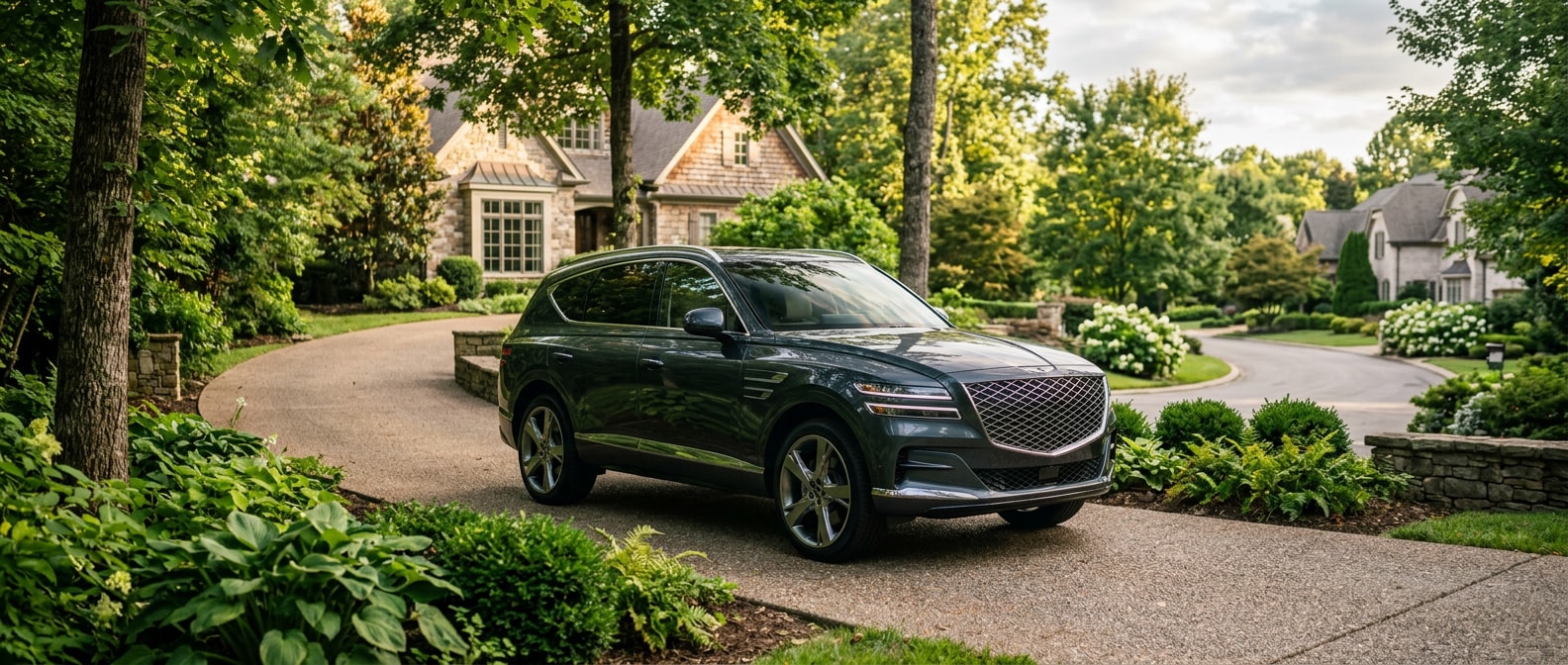
For most Brentwood buyers weighing these two, the 2026 Genesis GV80 comes out ahead. It tows 1,000 lbs more than the Aviator at the same trim level, it rides with a composure that suits the I-65 stop-and-go commute, and it arrives with more standard equipment. One caveat we won't soften: the third row is genuinely tight for adults, and if that row carries your family every day, the Aviator is the more practical answer.
Which Vehicle Actually Fits How Brentwood Buyers Use an SUV?
What decides this comparison is how you actually use the SUV, so the question worth answering is which one holds up on a 25-to-40-minute I-65 commute north toward Nashville, tows a boat to Center Hill Lake without strain, and seats the family for the school run without a compromise you'll notice. Those three axes (daily ride quality, towing ceiling, and third-row usability) separate these two more clearly than horsepower figures do.
| Decision Axis | 2026 Genesis GV80 | 2026 Lincoln Aviator | Edge |
|---|---|---|---|
| Base engine power | 300 hp / 311 lb-ft (2.5T) | 400 hp / 415 lb-ft (3.0L V6) | Aviator |
| Available V6 power | 375 hp / 391 lb-ft (3.5T) | 400 hp / 415 lb-ft | Aviator (marginal) |
| Max towing capacity | 6,000 lbs (all trims) | 5,000 lbs (all standard trims) | GV80 |
| EPA fuel economy (AWD) | 19 city / 24 hwy (2.5T AWD) | 17 city / 25 hwy (AWD) | GV80 city / Aviator hwy |
| Cargo (behind 2nd row) | 38.7 cu ft (2-row config) | ~19 cu ft (behind 3rd row) | GV80 |
| Max cargo (seats folded) | 71.7 cu ft | 75.9 cu ft | Aviator (slight) |
| 3rd-row adult legroom | 30.3 in | 29.2 in | GV80 (marginal) |
| Wheelbase | 116.3 in | 119.1 in | Aviator |
| Standard tech display | 27-inch curved OLED | Standard digital cluster | GV80 |
Browse our current GV80 inventory
The numbers tell a consistent story for most buyers in this market. If towing capacity and daily cabin refinement lead your list, the GV80 wins. If raw base-engine output is the priority and you need a slightly roomier third row for regular adult use, the Aviator makes its case.
How Do These Two Actually Ride on the I-65 Corridor?
Both ride well, but they ride differently, and the I-65 rush through Brentwood favors the GV80's calibration over the Aviator's straight-line punch. Morning traffic here isn't a smooth highway cruise. It runs as a rhythm of acceleration, braking, and stop-and-start from the Cool Springs interchange all the way north toward downtown. That pattern rewards a suspension tuned for composure under load changes, not one optimized purely for straight-line urgency.
Skip the spec sheet for a second and picture the commute. The GV80's available Electronically Controlled Suspension with Road Preview reads the surface ahead and adjusts the damping before the wheel gets there, which is a measurable engineering decision and it shows. The result in real stop-and-go is a cabin that stays settled when you're building speed off a light or absorbing a seam on the Bell Road section of I-65. The Aviator's 3.0-liter V6 produces 400 hp in standard trim and pulls harder off the line. That pull is real. There's no pretending the GV80's 2.5T matches it from a standing start, yet Brentwood's daily commute rewards measured, unhurried motion, and on that scale the GV80's ride character fits better, at least on the mornings I-65 backs up.
One thing our team keeps seeing on the lot is how the GV80's 27-inch curved OLED display stays striking in ways that don't wear off. Buyers who've driven German alternatives before (Brentwood sees its share of transplants from the Chicago and Atlanta markets who cross-shop the X5 and GLE) tend to call the GV80's interior more considered than they expected.
What About the Third Row and Towing? The Two Questions That Actually Decide the Sale
Both questions tilt toward the GV80 here, though the third row comes with a caveat you should hear plainly before you sign anything, because 30.3 inches of legroom works for children and manageable adult hops but never pretends to be a two-hour seat for a six-footer on the drive to Chattanooga. The Aviator's third row offers 29.2 inches (technically less, though its wider 119.1-inch wheelbase distributes that differently). Neither third row is truly roomy for adults. If your family regularly fills all three rows with adults, a larger three-row SUV is probably the right conversation to have before you spend in this segment.
- The GV80 tows up to 6,000 lbs when properly equipped with trailer brakes (consistent across the 2.5T and 3.5T)
- The Aviator is rated at 5,000 lbs in standard gas trim across all trim levels per Lincoln's official specifications
- For a pontoon boat or a single-axle camper trailer (typical use cases for Middle Tennessee lake weekends), the 1,000-lb gap is meaningful headroom
- The GV80's 3.5T twin-turbo V6 (375 hp, 391 lb-ft) makes pulling near that ceiling far more relaxed than the 2.5T, even though both carry the same rating
- The Aviator's Grand Touring PHEV configuration offers 494 hp, but its towing rating does not increase over the standard gas model
On the towing question specifically, the GV80 holds the stronger position for this market. Lake country isn't hypothetical here.
Is the Genesis GV80 the Right Answer for Your Brentwood Household?
For the buyer who commutes I-65 daily, wants towing with genuine headroom above 5,000 lbs, and values a cabin that doesn't need to announce itself, the GV80 is the more coherent answer, even as it concedes the Aviator's base-engine output and the slight third-row gap. Those are tradeoffs worth naming, not ones to wave away.
The buyer who should lean Aviator is more specific. You need the Grand Touring PHEV's 494-hp output and partial electric range, or your family genuinely uses the third row for adults on trips above an hour. Lincoln's cabin is quieter, in a traditional, American-luxury sense. That's a legitimate preference.
For the Brentwood buyer who has owned or cross-shopped European luxury and wants a vehicle that rewards that sensibility without the European ownership overhead, the GV80 earns the comparison on specifics, and it does so without leaning on brand credibility alone. That's a real shift from where Genesis stood.
Explore financing options for your GV80
Frequently Asked Questions
Which has more towing capacity, the 2026 Genesis GV80 or the 2026 Lincoln Aviator?
The 2026 GV80 is rated to tow up to 6,000 lbs when properly equipped with trailer brakes, consistent across both engine options. The 2026 Lincoln Aviator is rated at 5,000 lbs in standard gas trim across all trim levels, per Lincoln's official specifications. That 1,000-lb margin matters for Middle Tennessee buyers towing boats or single-axle camper trailers to the region's lakes.
Is the GV80 third row usable for adults?
The GV80's third row measures 30.3 inches of legroom, which works for children and short adult trips but not for regularly seating adults above average height on trips longer than 30 to 40 minutes. The Lincoln Aviator's third row measures 29.2 inches, technically less space, though the Aviator's longer 119.1-inch wheelbase changes how that space is distributed. Neither vehicle is a genuine seven-adult hauler. Let that lead your decision.
Does the GV80 or the Aviator make more sense as a daily commute vehicle for Brentwood?
For the I-65 stop-and-go commute between Brentwood and Nashville, the GV80's available Electronically Controlled Suspension with Road Preview is the more considered engineering choice. It reads the road ahead and adjusts damping before the wheel arrives, which keeps the cabin settled in the start-and-stop pattern typical of the morning northbound I-65 run. The Aviator's 3.0-liter V6 produces 400 hp and pulls harder from a standstill, which is genuinely noticeable. For most Brentwood commuters, though, ride composure over a 25-to-40-minute crawl matters more than peak acceleration, and the GV80's ride calibration is the better match for that daily pattern.
