
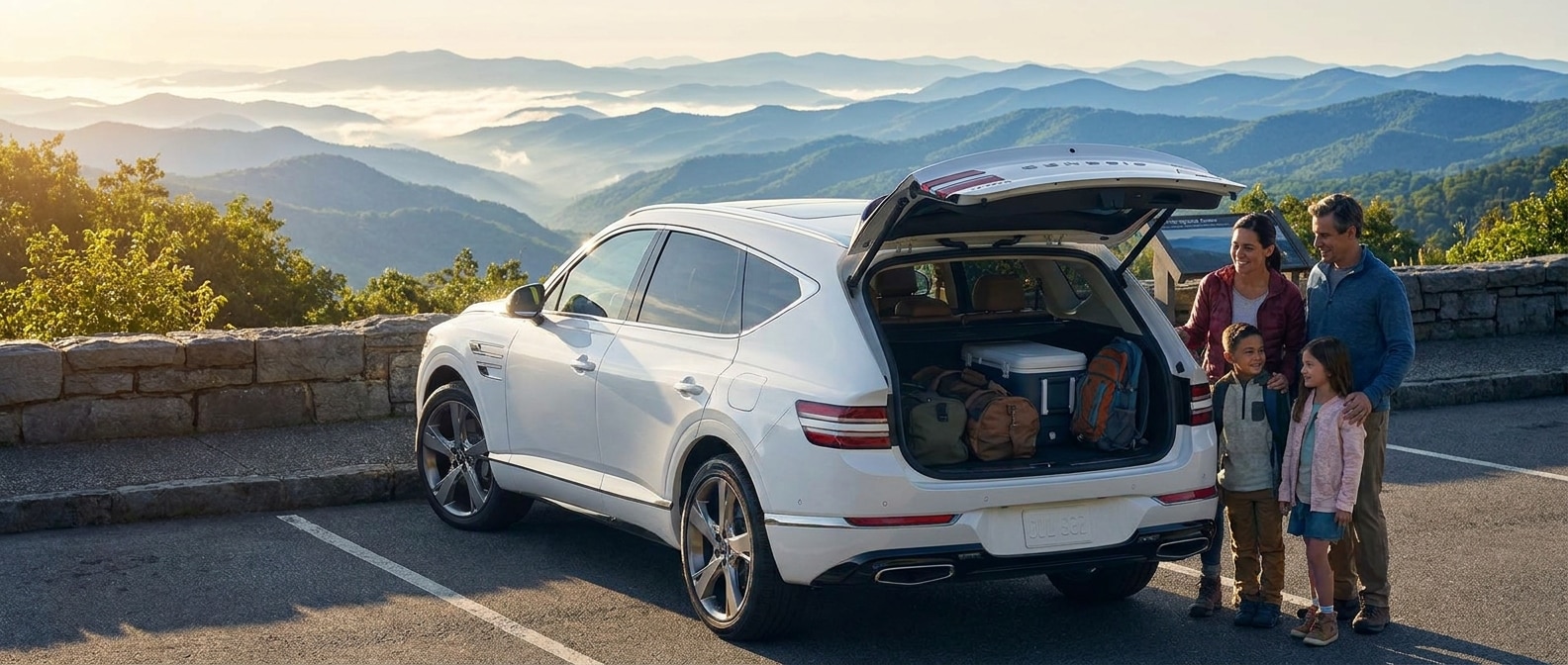
The Nashville-to-Gatlinburg run covers about 175 miles on I-40, and it finishes on winding mountain roads that climb toward 5,000 feet. Get the setup right and the GV80 makes the whole thing feel close to effortless. Skip a few of these steps and you'll arrive tired, cramped in the wrong seating configuration, and burning more premium fuel than you planned for.
The 2026 GV80 is built for exactly this kind of trip. Sort a handful of things before you back out of the driveway, and the list our team runs through is below.
What Goes on the GV80 Family Road Trip Checklist?
Print this and take it with you, then work through it the evening before departure rather than the morning of, when the driveway is chaos and someone can't find the stroller.
Seating and cargo setup
- Decide now whether you need the third row up or folded. The third row in the GV80 works for children and shorter adults on trips under two hours, though it gets uncomfortable for full-grown adults on a long haul. Fold it and you get up to 71.7 cubic feet of cargo volume behind the second row. Leave the third row up and that drops to 11.6 cubic feet behind the third row. Make the call tonight.
- Slide and recline the second row to the position your rear passengers prefer. The GV80's second-row seat tracks give you real adjustment range, with 38.7 inches of rear legroom when you configure it generously. Set it before you load luggage.
- Pack the cargo area so the heaviest bags sit low and toward the center. The hands-free power liftgate opens with a foot motion under the bumper, so load the night before and you won't be shuffling bags in the driveway at 7 AM.
Climate and seat settings
- Activate four-zone climate control if your trim includes it. Driver, front passenger, and rear zones each get independent settings. For an August drive through Middle Tennessee's heat, the rear zone matters as much as the front.
- Set ventilated seats for front and second-row passengers the moment you reach the highway. On a day when the ambient temperature is pushing 95 degrees, ventilated seating is what keeps the back-seat mood stable through Cookeville.
- If you have children in car seats, confirm the LATCH anchors are engaged firmly. The GV80's LATCH system is straightforward to reach, so check it anyway.
Drive mode and suspension setup
- Set drive mode to Comfort before departure. The Comfort setting softens suspension calibration, smooths shift points, and eases throttle aggressiveness. It's the right mode for I-40's long cruise sections and for passengers who didn't sleep well.
- If your GV80 has the Road Preview adaptive suspension, confirm it's active. The system uses a forward-facing camera to read pavement ahead and pre-adjusts the dampers before you hit a rough patch. On I-40's worn sections between Lebanon and Cookeville, you'll feel the difference.
- Check tire pressure. The GV80's standard on-board monitoring will flag low pressure, but start with correct inflation. The recommended figures live in the driver's door jamb. Under-inflated tires on a loaded vehicle hurt both ride quality and highway fuel economy.
Navigation and driver assist
- Load your destination into the GV80's navigation before you pull out. Real-time traffic integration works best with the full route from the start, so it can reroute before you're already committed to a bottleneck.
- Enable Highway Driving Assist 2 for the I-40 stretch if your trim includes it. It holds lane centering and following distance without constant steering input, which matters on a 175-mile highway leg with children in the car.
- Confirm the Blind-Spot View Monitor is on. Side-street merges on surface roads near Pigeon Forge and Gatlinburg run tight, and you'll want the camera feed in the instrument cluster the moment you activate your turn signal.
Fuel and pre-departure check
- Fill up before you leave Nashville. The 2026 GV80 requires premium unleaded fuel. Worth understanding clearly, the 3.5T V6 is EPA-rated at 19 miles per gallon combined, and the 2.5T AWD trims reach around 21 to 22 mpg combined. Premium fuel on a full tank for the round trip is the one real ownership friction point on this vehicle. It won't derail the trip, though it's a fact worth naming.
- Check the GV80's service status in the infotainment. If you're within 500 miles of a scheduled service interval, address it before you leave, not after.
Comfort and convenience items
- Sync your devices to Android Auto or Apple CarPlay before departure. The 27-inch OLED panoramic display in the 2026 GV80 makes in-cabin entertainment genuinely useful for rear-seat passengers on a long run.
- Pack the parking tag for Great Smoky Mountains National Park. Stopping for more than 15 minutes at any pull-off requires a parking tag. It's a small day-use fee, available at recreation.gov in advance. The GV80's USB-C ports let you show a digital pass on a phone without hunting for a printed copy.
Why These Items Actually Matter on a Tennessee Run
The checklist above isn't generic; it's built around what the I-40 corridor and the Smokies actually ask of a vehicle and the people inside it, from the pavement variation between Nashville and the mountains to the August heat load on the cabin to the way a loaded cargo hold behaves on a grade. Every line earns its place.
The GV70 is a capable companion, but its maximum cargo volume with the seats folded falls meaningfully short of the GV80's 71.7 cubic feet. If you're packing for four or five people on a multi-night trip, the GV80's cargo hold is what separates "we fit everything" from "somebody's bag is in a lap." You notice that distinction most when you're loading up at a cabin with two kids' bags, a stroller, and an extra cooler.
The Road Preview suspension is why the Comfort drive mode recommendation isn't soft thinking. The system actively pre-adjusts the dampers based on what the camera reads in the road ahead. Tennessee's interstate corridors have enough pavement variation between Nashville and the mountains that you notice when it's working. The GV80's cabin is one of the quieter environments in the segment, and that quiet compounds over a three-hour drive. Conversations stay at a normal volume. The backseat isn't an endurance test.
We want to be clear about the third row. The available third row in the 2026 GV80 serves two purposes well. It expands passenger count to seven on shorter trips, and it folds cleanly for cargo. What it won't do is make adults comfortable for three hours across I-40. If you're bringing grandparents or a third adult on this trip, the G80's rear bench offers 38.7 inches of rear legroom in a much more composed passenger environment. Know which problem you're actually solving before you configure the GV80.
The fuel question is a fair one to raise before this trip. Yes, the 3.5T V6 requires premium. Yes, the highway efficiency runs around 19 mpg combined per EPA estimates. On a Nashville-to-Gatlinburg round trip, that works out to roughly 18 to 19 gallons of premium fuel, worth factoring into your trip budget. The trade is a twin-turbo V6 producing 375 horsepower and 391 lb-ft of torque that makes the mountain grades between Cookeville and Knoxville feel genuinely easy, without ever asking you to downshift hard or stress the transmission. For most families doing this trip, that trade is worth it.
| Checklist Item | Why It Matters on a Tennessee Drive |
|---|---|
| Third-row decision (up vs. folded) | Determines cargo space (71.7 vs. 11.6 cu ft behind 3rd row) |
| Second-row seat position | 38.7 in. of legroom available; set before bags go in |
| Comfort drive mode | Smooths I-40 cruise and reduces cabin fatigue on long runs |
| Road Preview suspension active | Pre-adjusts dampers on worn pavement before you feel it |
| Four-zone climate configured | Rear zone critical in August Tennessee heat |
| Ventilated seats on | Keeps back-seat mood stable through Middle Tennessee's summer |
| Premium fuel, full tank | 3.5T is EPA-rated 19 mpg combined; plan fill-up in Nashville |
| Highway Driving Assist 2 on | Reduces steering fatigue on the 175-mile I-40 stretch |
| Navigation loaded at departure | Traffic rerouting works best with full route from the start |
| Parking tag for the Smokies | Required for stops over 15 minutes in Great Smoky Mountains NP |
Your Print-and-Go Recap Before You Leave Nashville
Run through this the night before you leave, ideally after the kids are down, so you're not fiddling with menus at a gas station off I-40 with a full load in the back.
- Third row up or folded. Commit to the configuration.
- Second-row seat position set, LATCH anchors checked.
- Four-zone climate and ventilated seats confirmed.
- Drive mode to Comfort; Road Preview active.
- Tire pressure correct per door jamb spec.
- Navigation loaded; Highway Driving Assist 2 enabled.
- Blind-Spot View Monitor on.
- Devices synced to CarPlay or Android Auto.
- Tank filled with premium unleaded before leaving Nashville.
- Parking tag for the Smokies visit downloaded or printed.
The GV80 handles everything Tennessee puts in front of it on a family trip. The preparation above is what lets the vehicle do that work quietly, without you managing problems from the driver's seat.
Frequently Asked Questions
Is the GV80 third row suitable for adults on a long Tennessee road trip?
Honestly, it's better suited for children and shorter adults on extended drives. The third-row legroom in the 2026 GV80 measures 30.3 inches, comfortable for smaller passengers but tight for most adults over five and a half feet on a trip longer than 90 minutes or so. For longer hauls with a full adult passenger count, folding the third row and prioritizing second-row comfort is the better configuration. If your family regularly needs seven adult seats on road trips, that's a conversation worth having before you choose a trim.
Does the GV80 need premium fuel, and does that change the road trip math?
It does require premium unleaded. The 3.5T V6 is EPA-rated at 19 miles per gallon combined, and the 2.5T AWD reaches roughly 21 to 22 mpg combined. On a round trip from Nashville to the Smokies and back, plan your fuel stops accordingly and budget for premium at the pump. It's the one ongoing cost that surprises some owners, mostly at the first fill-up. In return you get 375 horsepower and 391 lb-ft of torque from the V6, which makes the grades east of Cookeville and the mountain approach toward Knoxville feel composed and unhurried. For most Tennessee families doing this kind of trip regularly, that's a fair trade.
