
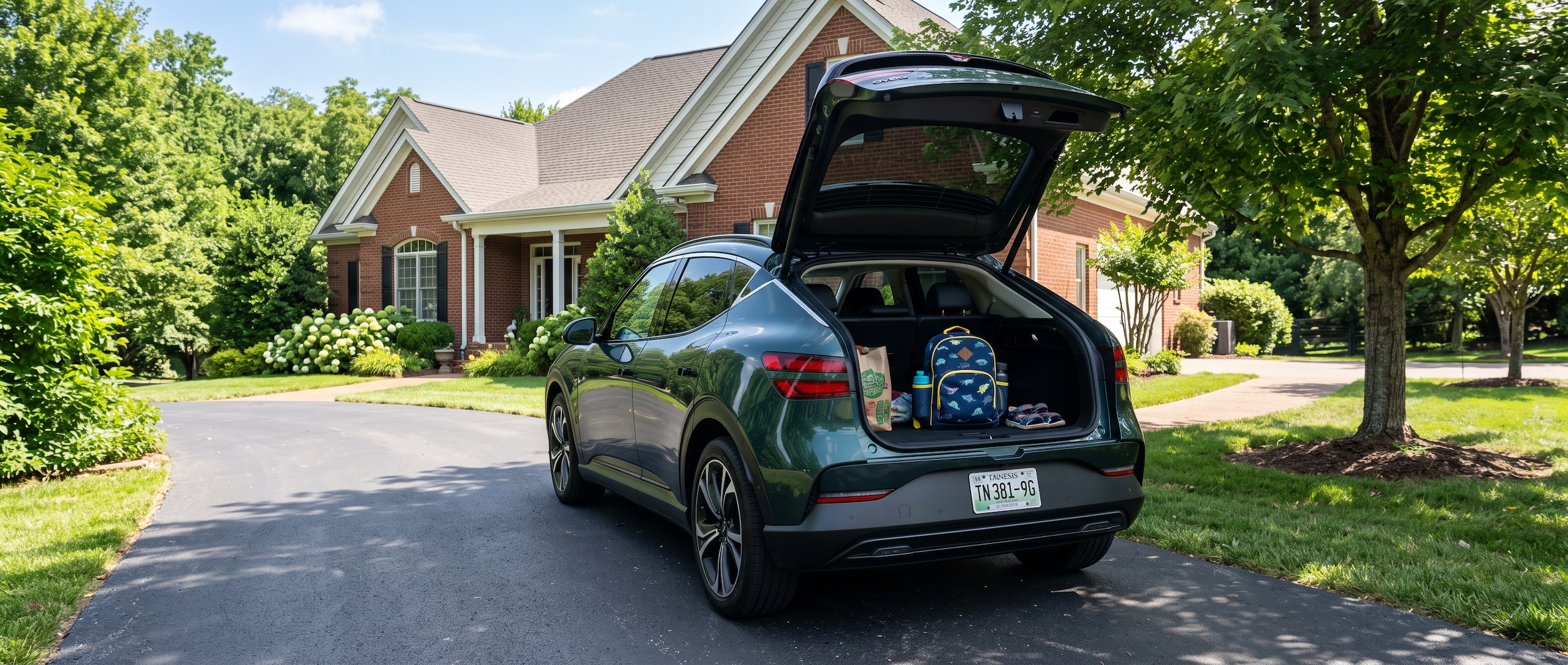
Yes. For a Franklin family running a daily I-65 commute into Nashville and weekend trips across Middle Tennessee, the 2026 Genesis GV60 earns its place. Genesis rates its EPA-estimated range at up to 306 miles on the base trim, it charges from 10% to 80% in roughly 18 minutes at a 350 kW station, and its native NACS port now connects to Tesla Supercharger infrastructure without an adapter. It seats five, it's genuinely quiet, and it carries the considered interior the Genesis name requires. The caveat is real. Cargo volume is compact, and families with two car seats will want to understand that trade-off before they commit.
What Does the 2026 GV60 Actually Deliver for a Family in Franklin?
The GV60 delivers more than the spec sheet implies in the areas a family actually leans on, and less than you might hope in one specific area worth planning around, where range and charging quietly cover the week and cargo is the number you'll want to sit with before you sign.
For 2026, Genesis upgraded the GV60 to a larger 84-kilowatt-hour battery pack, replacing the 77.4-kWh unit in the previous model. That 84 kWh pack, paired with an 800-volt architecture, delivers an EPA-estimated range of up to 306 miles. For a family based in Franklin, that number matters in a practical way. The downtown Nashville run is roughly 20 miles each way. A typical week of school drop-offs, errands along Cool Springs, and a couple of commutes doesn't touch 306 miles. You're home-charging overnight and largely ignoring the public network Monday through Friday.
Every 2026 GV60 uses the same 84 kWh battery. The base rear-wheel-drive trim returns the full 306-mile EPA range, while the AWD versions draw more power and land at 282 miles (base AWD) or 267 miles (Advanced AWD). For most Franklin families, the RWD or base AWD covers the real-world math. No compromise.
| Trim | Drive | EPA Range | Power |
|---|---|---|---|
| Standard | RWD | 306 mi | 225 hp |
| Standard | AWD | 282 mi | 314 hp |
| Advanced | AWD | 267 mi | 314 hp |
| Performance | AWD | 252 mi | 483 hp (Boost) |
Cargo is the one area that asks for level expectations. The GV60 offers approximately 24.0 cubic feet of cargo space behind the second row and roughly 54.7 cubic feet with the rear seats folded. Its compact size and sloping roofline limit cargo space; at 24 cubic feet behind the rear seats, it sits well below a Tesla Model Y in raw volume. The cargo hold is small. Two kids' soccer bags and a stroller will fill that bay. That's a real trade-off families should walk through with us, though none of it disqualifies the car.
Browse GV60 availability at Genesis of South Nashville
How Does the GV60 Handle Franklin's Charging Reality?
The GV60 handles Franklin's charging reality better than most first-time EV buyers expect, thanks to a public network denser than its reputation, a native Tesla plug that finally arrived for 2026, and a home-overnight routine that keeps public chargers in the backup role for most weeks. Charging anxiety is the reason a lot of Tennessee families still hesitate on EVs. Let's be direct about what the infrastructure here actually looks like.
Franklin has 82 public charging station ports, Level 2 and Level 3, within 15 kilometers of the city center. The Nashville-Davidson-Murfreesboro-Franklin metro has 1,452 public charging stations overall, including 130 DC fast chargers.
For a GV60 owner, the more relevant fact is the NACS port. For 2026, the GV60 now comes with a native North American Charging Standard port, which means drivers can charge at Tesla Supercharger stations without an adapter. Those numbers open access to over 36,000 Tesla Superchargers across the U.S. There's a Supercharger location near Old Hickory Boulevard, just off I-65 in the Brentwood area, a practical stop for any family heading south from Franklin or returning from Nashville. Franklin itself sits directly on a federally designated NEVI Alternative Fuel Corridor, so the fast-charging infrastructure here is a priority for state and federal investment, not an afterthought.
When you do need a fast charge, the 800V architecture keeps it efficient. The GV60 goes from 10% to 80% in approximately 18 minutes on a 350 kW DC fast charger. Call it a coffee stop, not a layover.
Learn about GV60 ownership service at Genesis of South Nashville
Is the GV60 Cabin Genuinely Family-Workable?
The GV60 cabin works for a family in the ways that count, with five seats, a genuinely quiet ride, rear climate vents, and a 27-inch OLED screen your kids will claim within a mile, though the LATCH access and the sloping roofline both ask for a little planning.
For 2026, the GV60 carries one of the most advanced infotainment setups in the segment, with a 27-inch OLED screen spanning about two-thirds of the instrument panel. Rear passengers get their own climate vents, and the available heated rear seats are the kind of detail that earns loyalty on a cold Tennessee morning. Rear legroom is real; adults sit comfortably, though the sloping roofline trims rear visibility a touch. On a frosty Franklin morning the flush door handles also need a beat to present themselves before you can load kids in.
On child seats, the GV60 comes with two complete sets of LATCH connectors at the rear outboard seats and a tether anchor for the rear middle seat. IIHS rated this LATCH system "Acceptable," its second-highest rating, because the lower anchors sit deep in the seat cushions. Fishing for them makes installation a little less intuitive than in a larger SUV. It works. You'll just want to do a practice install before delivery day, not in the Cool Springs parking lot with a toddler in your arms.
Available Vehicle-to-Load capability turns the GV60's battery into a portable power source, handy at soccer fields, at campsite stops along the I-65 corridor, or during the summer thunderstorm season that sometimes pulls power across Middle Tennessee. Small feature, real usefulness for a family already leaning into a lighter footprint.
Explore the GV80 if your family needs three rows
Does Choosing an EV Actually Support the Values Behind the Purchase?
Choosing the GV60 does support the environmental values behind the purchase, and by a wide margin rather than a rounding error, since a zero-tailpipe EV running on Tennessee's grid still carries a substantially lower lifecycle footprint than the comparable gas SUV a family would otherwise be driving.
Does the green story hold up, or is it mostly a feeling? The math holds up, and it isn't close. A comparable midsize gasoline SUV generates approximately 5.7 tons of CO2 per year, while the GV60 produces zero tailpipe emissions. Tennessee's electricity grid mix matters here, but EVs in this region still carry a lower lifecycle carbon footprint than a combustion equivalent, and that advantage grows as the Tennessee Valley Authority's grid continues to add renewable capacity.
The 800V architecture does more than speed up charging. Under repeated fast-charge cycles it stays more thermally stable, so the battery management system doesn't have to work as hard to protect the cells. A healthier battery over the vehicle's life is a quieter form of sustainability the brochure rarely mentions.
The 2026 model's 84 kWh battery replaces the 77.4 kWh pack from the prior model year. More capacity buys more than range. It lets the battery swing between a higher and lower state of charge less aggressively on a typical daily commute, which tends to preserve long-term health. Most eco-conscious buyers care about that. They rarely get a straight answer on it.
Frequently Asked Questions
Is the 2026 Genesis GV60 big enough for a family of four in Franklin?
It seats five, and a family of four will be comfortable. Rear legroom is genuine, both outboard seats include LATCH connectors for car seats, and adults fit without feeling cramped. The honest limit is cargo: approximately 24 cubic feet behind the second row is workable for daily family errands but gets tight on road trips with full gear and two car seats installed. If your family regularly hauls significant cargo, the larger GV80 is worth a look.
How long does it take to charge the GV60 near Franklin, TN?
On a home Level 2 charger (240V), a full charge takes approximately 7 to 8 hours overnight. On a 350 kW DC fast charger, Genesis states the GV60 goes from 10% to 80% in roughly 18 minutes. The 2026 model's native NACS port gives you access to the Tesla Supercharger network, including the station near Old Hickory Boulevard off I-65, without needing an adapter.
Is the GV60 a practical choice if I've never owned an EV before?
For most Franklin families whose daily driving stays well under 100 miles, yes. The 306-mile EPA-estimated range (RWD trim) means you're home-charging overnight and rarely thinking about public charging during the week. The MyGenesis app handles route planning and charger locations for longer trips. The adjustment is behavioral, not mechanical: treat the GV60 like a phone, plug it in at home each night, and range anxiety largely disappears.
