
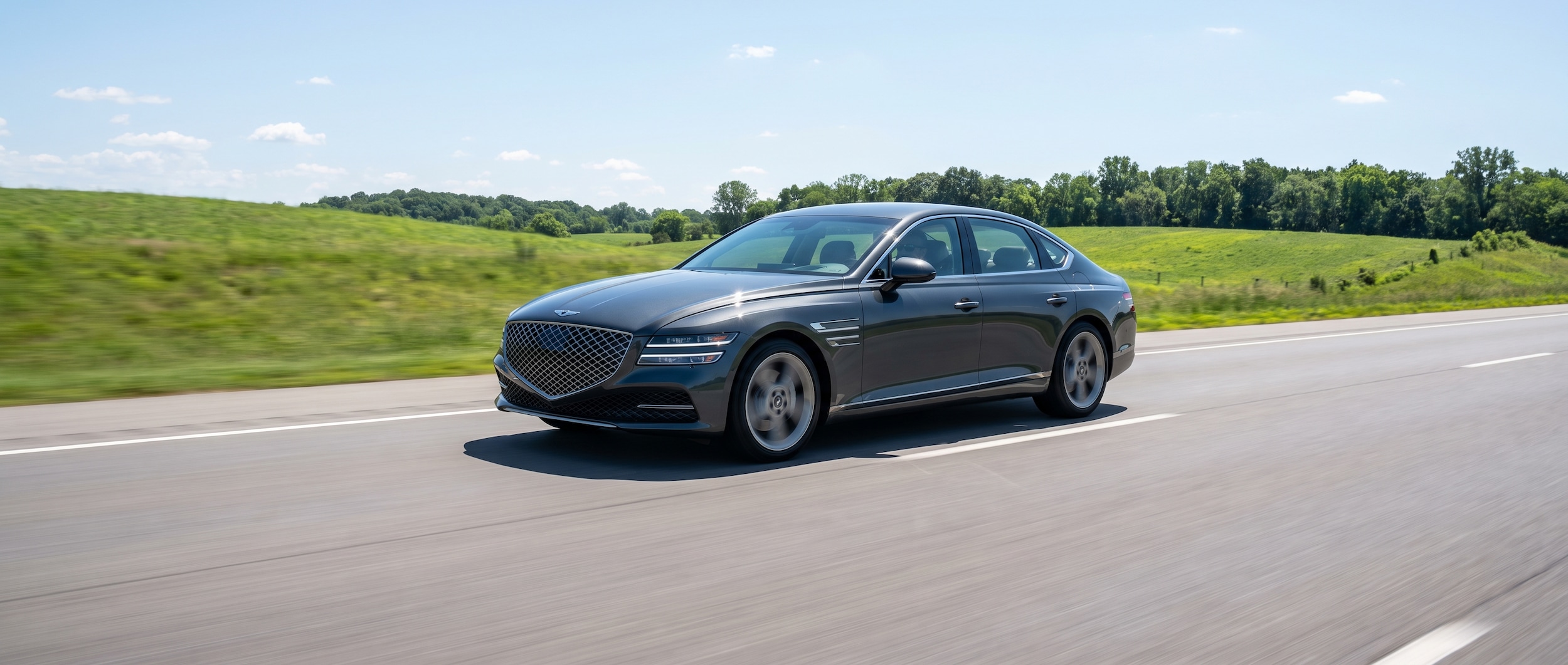
The last 100 miles of I-40 between Nashville and Memphis have earned a specific reputation among frequent travelers: flat, straight, 70 mph, very little to hold your attention. One forum regular who has made the drive dozens of times described it as "miles and miles of miles and miles." That is not a complaint about Tennessee. It is a description of exactly the kind of highway segment that produces fatigued drivers, and the 2026 Genesis G80 was put together with that kind of drive in mind.
The short answer: monotonous high-speed driving depletes attention faster than complicated driving does, and the G80's three standard fatigue countermeasures -- its Ergo Motion driver's seat, its acoustic cabin, and Highway Driving Assist -- work together to address the specific mechanics of that depletion. If you are making the Nashville-to-Memphis run for business and need to walk into a meeting composed, those systems matter more than horsepower.
Browse the G80 lineup at Genesis of South Nashville and read on to understand what each one actually does.
What Is Actually Happening When You Feel Tired on a Long Flat Interstate?
Driver fatigue on a stretch like western I-40 is not simply about hours on the road. It follows a more specific pattern.
| Symptom You Notice | What Is Actually Happening | What Makes It Worse | What Addresses It |
|---|---|---|---|
| Eyes feel heavy past the halfway point | Monotonous visual field suppresses alertness -- no curves, no elevation change, no landmarks | Flat, featureless terrain (western I-40 through West Tennessee) | Acoustic quiet that reduces ambient noise stress |
| Lower back aches after 90+ minutes | Seat cushion compresses under sustained weight; lumbar support stays fixed as posture drifts | A static seat with no micro-adjustment | Ergo Motion seat with seven air cells cycling support |
| Attention drifts on straight sections | Vigilance decrement -- the brain's known response to low-stimulus monotony | 70 mph straight interstate with minimal traffic variation | Highway Driving Assist reducing active steering workload |
| Tension in shoulders and neck | Sustained grip on the steering wheel at highway speed with minor course corrections | Poorly weighted or light steering requiring constant small inputs | Well-sorted steering with lane-centering assistance active |
The Nashville-to-Memphis run covers 210 miles via I-40, with speed limits holding at 70 mph across most of the corridor. That means roughly three hours of sustained high-speed driving on one of the most consistent -- and consistently uneventful -- stretches of interstate in the South. Traffic does concentrate at two points: the Nashville metro merge in the first 15 miles and the Memphis metro approach in the final 10 miles, with both potentially adding five to 15 minutes during weekday peak hours. The middle 185 miles demand a different kind of attention: the steady, low-stimulus kind that fatigues you without signaling that it is doing so.
The G80's Response Is Layered, Not Single-Feature
Most vehicles in this segment address highway comfort through seat adjustment and good sound insulation. The 2026 G80's approach is more systematic, and the 2026 model year made a specific change that matters for this kind of drive.
The Ergo Motion seat is now standard across every 2026 G80 trim.
Following customer feedback, Genesis made the Ergo Motion driver's seat standard across the 2026 G80 lineup. The seat uses seven air pockets: two in the bottom cushion, three in the backrest, and one in each side bolster. During long-distance journeys, the Ergo Motion seat prevents "seat sagging" -- the feeling of sitting lower as the cushion continuously compresses -- and its smart posture support function inflates the backrest air pockets to reduce driving fatigue. In practice: it periodically cycles through micro-adjustments that keep circulation moving in your lower back and thighs, the two areas most affected by sustained seated driving. You notice this mostly as a subtle shift in support rather than a movement, and it happens without requiring any input from you.
Clinical research into postural fatigue shows that when a body holds the same position for 45 minutes or more, circulation in the lower back and thighs begins to slow -- micro-adjustments restore it. A three-hour run puts you well past that threshold twice over.
Schedule a service appointment or configuration consultation at Genesis of South Nashville to see how the Ergo Motion system feels in person.
The acoustic cabin removes a second fatigue driver.
Extensive sound deadening and dual-pane glass make the G80 one of the quieter highway cruisers in its class. Road and wind noise at 70 mph create sustained low-level acoustic stress -- the kind you do not consciously register but that your nervous system responds to across three hours. The G80's cabin manages that load rather than asking your attention to filter it out.
Highway Driving Assist reduces the low-stimulus steering workload.
Highway Driving Assist is a Level 2 driver-assistance system that combines adaptive cruise control with stop-and-go capability, lane-centering assistance, GPS data, and route navigation to reduce driver stress and fatigue. On a well-marked interstate like I-40, it holds the G80 centered in its lane and maintains following distance through traffic variations. Compared to many Level 2 systems, Highway Driving Assist is notably smooth in operation -- the lane-keeping inputs are subtle enough that the driver does not feel a need to regularly override the technology, which itself is fatiguing.
See how the GV80 applies the same Highway Driving Assist system if you prefer an SUV footprint for the same corridor.
When to Adjust the System Yourself vs. When to Contact the Service Team
The G80's driver-assistance and seat systems are calibrated at the factory, but there are settings you control directly and a narrower set of conditions where a service visit makes sense.
Things you configure yourself:
- Highway Driving Assist sensitivity. The system has a "based on driving style" learning mode. Owners who find the lane-centering inputs feel slightly off should set it to "based on driving style" mode, which allows the system to learn and match their natural preferences. This is the first adjustment to make if the system feels like it is fighting your inputs on wide interstate lanes.
- Ergo Motion seat cycle. The seat's posture support activates automatically, but massage modes -- relaxation, reset, and stretch -- are selectable from the seat controls. For the I-40 run, the relaxation or reset mode on a rolling cycle works well starting around the 45-minute mark.
- Driver Profiles. The G80's Driver Profiles allow near-complete customization: seat position, sound settings, and navigation preferences are stored so your G80 is configured to your setup from the moment you start. If multiple drivers use the vehicle, each profile saves its own Highway Driving Assist sensitivity preferences as well.
When to involve the service team:
- If Highway Driving Assist disengages unexpectedly or the lane-centering camera gives persistent low-visibility warnings on clear highway days, that points to a calibration check or sensor inspection.
- If the Ergo Motion seat stops cycling or a specific air cell feels consistently under-inflated after confirmed activation, the seat's control module warrants a diagnostic appointment.
- For a new G80 or one under significant mileage accumulation, a scheduled service review of the camera and radar sensors -- the hardware Highway Driving Assist runs on -- keeps the system operating as designed.
Book a service appointment with Genesis of South Nashville to address any driver-assistance system calibration or seat system concerns.
The fuel-economy context for the I-40 corridor:
The 2026 G80 2.5T AWD carries an EPA estimate of 20 mpg city and 29 mpg highway. At 29 mpg highway over a 210-mile run, the G80 uses roughly 7.2 gallons one way -- which means a Nashville-to-Memphis trip in the 2.5T can be completed without a fuel stop, assuming you leave Nashville with a full tank. The 3.5T is a different calculation: the 3.5T AWD is EPA-rated at 16 mpg city and 24 mpg highway. At that figure, the same 210-mile run uses about 8.75 gallons -- still within a typical tank range, but worth noting before a very early departure.
Frequently Asked Questions
Does the Ergo Motion seat actually reduce fatigue on a three-hour drive, or is it marketing?
The system is mechanical, not aspirational. The Ergo Motion seat uses air pockets to customize seating posture based on the passenger's weight: seven total, with two in the bottom cushion, three in the backrest, and one in each side bolster. The cycling of those cells provides micro-adjustments that keep circulation moving in the lower back and hips -- the areas most affected by sustained seated posture. Smart Posture Assist engages automatically to adjust and regulate posture, with configurable settings designed to reduce back pain and fatigue, accessible from the seat controls at any point. Whether you notice the effect depends partly on your baseline sensitivity, but the mechanism behind it is straightforward physiology rather than a feature name.
Is 29 mpg highway realistic on I-40 at 70 mph?
The EPA rates the 2026 G80 2.5T AWD at 29 mpg highway. EPA highway estimates are based on a test cycle that includes speeds up to 80 mph but averages in the mid-to-upper 48 mph range, which is more favorable than sustained 70 mph cruising. Real-world highway fuel economy at a consistent 70 mph will typically come in somewhat below the EPA highway figure -- expect mid-to-upper 20s on the I-40 run. The 2.5T's highway figure is competitive for a 300-horsepower AWD sedan, and the G80's aerodynamic profile -- a flowing roofline, active grille management on higher trims -- is calibrated for exactly this kind of sustained highway load.
