
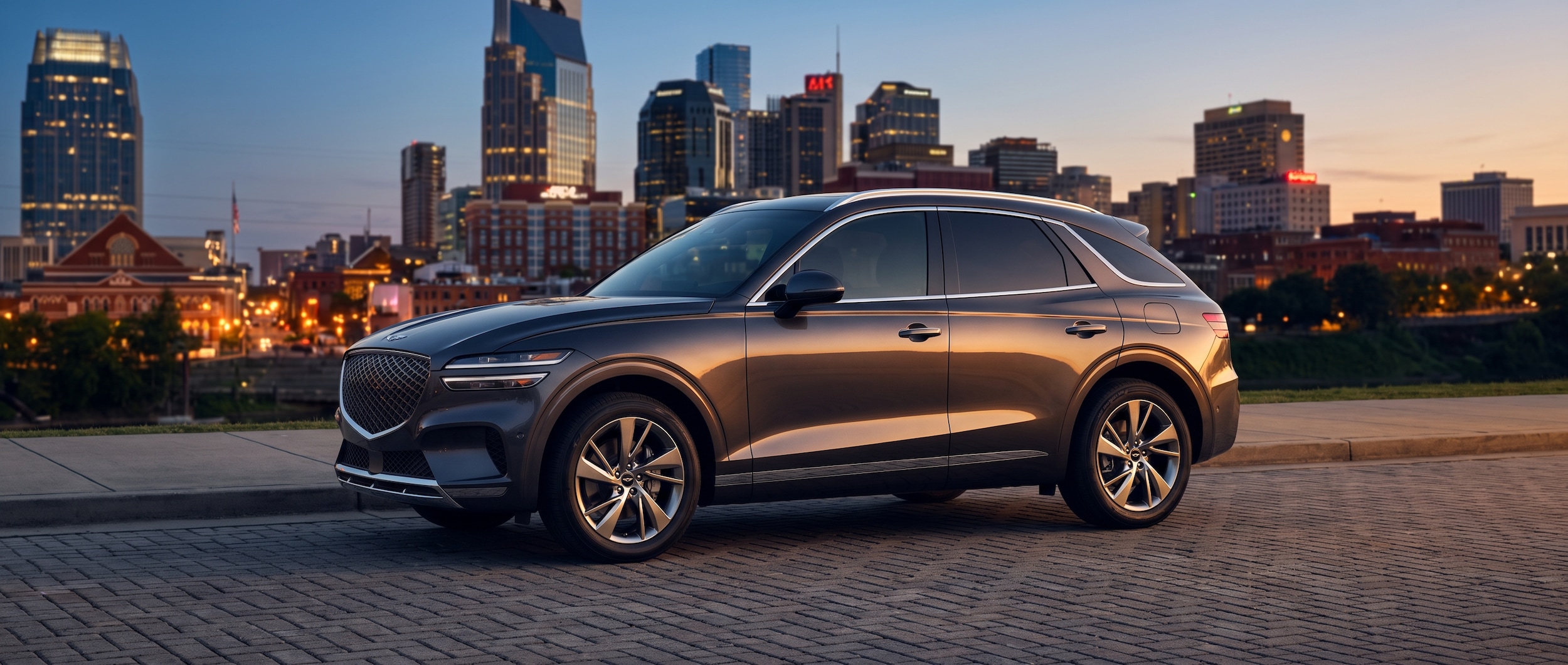
Both of these are genuinely good vehicles, but they're good in ways that match different lives, and the differences between them are more concrete than a typical comparison lets on.
If you're cross-shopping the 2026 Genesis GV70 and the 2026 BMW X3 in the Nashville market, here's what we'd want you to know before you decide. The GV70 gives you more standard power, a richer cabin at comparable trim levels, and a stronger ownership-protection posture. The X3 gives you meaningfully better fuel economy and the most cargo flexibility in the segment. Neither is a compromise. They suit different driving lives.
- The 2026 GV70's 2.5T produces 300 hp standard; the X3 xDrive30 starts at 255 hp with a mild-hybrid assist.
- The X3 carries a genuine cargo advantage: 31.5 cubic feet behind the rear seats vs. the GV70's 28.9, and 67.1 vs. 56.9 cubic feet with seats folded (per IIHS and published specs).
- The X3 xDrive30 returns an EPA-estimated 27 city / 33 highway mpg; the GV70 2.5T AWD is rated at 20 city / 28 highway.
- Both earned IIHS Top Safety Pick+ for 2026.
- The GV70 wins on cabin feel, standard equipment depth, and long-term ownership protection (decisively).
- Which fits you comes down to one question: do you load cargo regularly, or does the interior experience drive your commute?
Nashville draws buyers from everywhere now. Some arrive having owned European luxury before and know what the BMW badge means; others have done the Genesis research carefully and want to know if the case actually holds up in person. We find both conversations settle faster once someone sits in both vehicles, because the specs alone don't carry the full weight of what separates these two.
Browse our current GV70 inventory to see what's available in South Nashville.
How Do the 2026 GV70 and X3 Compare on the Specs That Matter?
| Category | 2026 Genesis GV70 (2.5T AWD) | 2026 BMW X3 (xDrive30) |
|---|---|---|
| Base engine output | 300 hp / 311 lb-ft torque | 255 hp / 295 lb-ft torque |
| Top engine option | 375 hp twin-turbo V6 (3.5T) | 393 hp inline-six (M50 xDrive) |
| Transmission | 8-speed automatic | 8-speed Steptronic automatic |
| Drivetrain | AWD standard | xDrive AWD standard |
| EPA fuel economy (base engine) | 20 city / 28 hwy (AWD) | 27 city / 33 hwy |
| Cargo (seats up / folded) | 28.9 / 56.9 cu-ft | 31.5 / 67.1 cu-ft |
| IIHS rating (2026) | Top Safety Pick+ | Top Safety Pick+ |
| Display | 27-inch integrated OLED | 14.9-inch BMW Curved Display |
| Towing capacity | 3,500 lbs | 4,001 lbs (xDrive30) |
Genesis lists the GV70 2.5T AWD at 300 horsepower and 311 lb-ft of torque. BMW lists the X3 xDrive30 at 255 horsepower and 295 lb-ft of torque, with a 48-volt mild-hybrid system working alongside that figure. On fuel economy, the EPA rates the X3 xDrive30 at 27 city and 33 highway mpg, while the GV70 2.5T AWD comes in at 20 city and 28 highway. That seven-mile-per-gallon highway gap deserves a plain conversation, and we'll have it below.
Where Does the GV70 Genuinely Lose to the X3?
Fuel economy is where the X3 wins without much argument, and the margin is real enough to affect a multi-year ownership picture. Seven miles per gallon on the highway isn't a rounding error; for a buyer running I-65 between Nashville and Franklin every working day, that difference accumulates in ways worth pricing out before signing anything.
Cargo is the second structural gap. The X3's more upright roofline lets it fold flat to 67.1 cubic feet, per published specs. The GV70's swept, raked silhouette is what gives it the presence it has on the road, and that same geometry is why folded cargo comes in at 56.9 cubic feet. Ten cubic feet sounds abstract until you're standing in a parking lot trying to fit a paddleboard or a weekend's worth of camping gear. For a buyer who loads up regularly, it's a consistent friction the GV70 simply can't engineer away at any trim level.
Towing is worth a line, too. Per BMW specifications, the X3 M50 xDrive tows up to 4,850 lbs when equipped, against the GV70's 3,500 lbs. If you're moving a boat between Old Hickory Lake and storage, that ceiling matters.
Where Does the GV70 Win?
The cabin is where most people feel the GV70 pull away from the X3, and we'd rather describe what we see on the lot than editorialize about it. The 2026 GV70 comes standard with a 27-inch integrated OLED display, dual-pane laminated side glass, and heated and ventilated front seats arriving earlier in the trim walk than the X3 offers equivalent kit. Genesis forums consistently flag rear seat comfort as a genuine GV70 strength over the X3; that lines up with what we observe when customers spend time in both back seats.
Power delivery matters, too. Three hundred horsepower from the 2.5T means the GV70 moves with real intention at its base configuration, without asking you to step up a trim or two to feel it. The X3 xDrive30 at 255 hp is capable, and nobody's complaining about it on a daily commute, but the GV70 doesn't hold anything back at the entry point.
Ownership protection is where the two brands diverge most clearly for long-term buyers. Genesis structures its coverage tiers more broadly than BMW's standard new-vehicle program, an advantage that carries real weight for a buyer planning to hold the vehicle five or six years. It is worth asking your sales consultant about the specific terms at the time of purchase.
Safety lands as a genuine draw. Both the 2026 GV70 and the 2026 X3 earned IIHS Top Safety Pick+ designation, and the GV70 also carries a 5-Star Overall Safety Rating per published NHTSA data. Forward Collision-Avoidance Assist, Blind-Spot Collision-Avoidance Assist, Lane Keeping Assist, and Rear Cross-Traffic Collision-Avoidance Assist all come standard on the GV70. You're not trading safety for the design-forward exterior.
If interior scale matters more than engine character, the GV80 is worth a look before you finalize.
Pros and Cons at a Glance
| GV70 Pros | GV70 Cons |
|---|---|
| Higher standard horsepower (300 vs. 255) | Lower fuel economy than X3 (20/28 vs. 27/33 mpg) |
| Richer cabin feel and standard equipment depth | Smaller cargo volume (seats up and folded) |
| Broader ownership protection posture | Raked roofline limits total cargo flexibility |
| 27-inch OLED display standard on 2026 refresh | Fewer trim configurations than prior X3 generations |
| IIHS TSP+ and NHTSA 5-Star safety ratings | Less towing capacity than X3 when equipped |
| Distinctive, design-forward exterior | Narrower brand service network than BMW |
| X3 Pros | X3 Cons |
|---|---|
| Substantially better fuel economy (27/33 mpg) | Lower standard horsepower at base (255 hp) |
| Largest cargo volume in the segment (67.1 cu-ft) | Cabin materials feel more restrained at base trim |
| Mild-hybrid system improves real-world efficiency | Full redesign was 2025; 2026 is mostly a carryover |
| Higher towing capacity when equipped | Smaller standard display than GV70 |
| Strong dealer service network | M50 trim carries a significant price premium |
Which Buyer Does Each SUV Actually Fit?
Getting this question right is what separates a useful comparison from a spec-sheet recitation, so we'll be precise about it.
The GV70 is the right choice if: the interior is where you spend your time, not the cargo bay. Nashville's healthcare and finance professionals driving 20-30 miles of highway per day on I-24 or I-65 who want a cabin that feels intentional from the moment the door closes. The buyer who cross-shopped a Q5 or GLC, sat in the GV70, and found the materials conversation more interesting. The buyer for whom the breadth of Genesis's ownership-protection program carries real weight, because they plan to keep the vehicle five or six years and want to minimize unexpected exposure.
The X3 is the right choice if: you're moving gear. If your weekends involve Radnor Lake trail runs with the dogs, a paddleboard, or camping equipment that needs to fit flat, the X3's 67.1 cubic feet of folded cargo is a genuine practical advantage. The buyer who wants BMW's established driving character, a mild-hybrid system working in their favor on a fuel bill, and doesn't mind that every third vehicle in the Cool Springs parking deck is wearing the same badge. The buyer scaling up into the M50 for a more athletic experience.
When shoppers come in having driven both, the ones who walk away from the GV70 almost always cite fuel economy or cargo. The ones who walk away from the X3 almost always cite the interior. Both patterns point at the same thing: pick your priority, and the choice comes into focus quickly. We'd also note that summer heat in Tennessee loads the A/C hard on any vehicle; the GV70's standard dual-pane laminated glass is the detail that quietly earns its keep on a July afternoon before you've even left the lot.
If driver engagement is a priority, the G70 sedan is worth a separate conversation before you commit to either SUV.
Frequently Asked Questions
Is the 2026 Genesis GV70 more powerful than the 2026 BMW X3?
At the base engine, the GV70 holds a clear advantage: Genesis rates the 2.5T at 300 horsepower and 311 lb-ft of torque with AWD standard, while BMW rates the X3 xDrive30 at 255 horsepower and 295 lb-ft of torque, supplemented by a 48-volt mild-hybrid system. The X3's top engine, the M50 xDrive's inline-six, produces 393 hp, which is higher than the GV70 3.5T's 375 hp, but it also carries a significant price premium. For most buyers choosing between base and mid-level trims, the GV70 has the power advantage without requiring an upgrade to get there.
Which has better fuel economy: the GV70 or the X3?
The X3 xDrive30 has a substantial lead here. The EPA rates the X3 xDrive30 at 27 city and 33 highway mpg; the GV70 2.5T AWD is rated at 20 city and 28 highway, per EPA estimates. The X3 benefits from a 48-volt mild-hybrid system that the GV70 does not offer on its gasoline powertrain. If fuel economy is a primary concern, the X3 holds a clear advantage. The GV70 compensates with higher standard output, but the efficiency gap is real and worth factoring into a multi-year cost picture.
Do both the 2026 GV70 and 2026 X3 earn strong safety ratings?
Both earned IIHS Top Safety Pick+ for 2026, which is the highest IIHS designation available. The GV70 also carries a 5-Star Overall Safety Rating from NHTSA. Standard active safety technology on the GV70 includes Forward Collision-Avoidance Assist, Blind-Spot Collision-Avoidance Assist, Lane Keeping Assist, and Rear Cross-Traffic Collision-Avoidance Assist. The X3 similarly comes standard with forward-collision mitigation and blind-spot monitoring. On safety, these two vehicles are well-matched.
