
Both the 2026 Genesis GV60 and the 2026 Hyundai IONIQ 5 share the same 800-volt E-GMP platform, the same NACS port that plugs straight into Tesla Superchargers, and EPA-estimated range figures that put either car well beyond any Nashville commute you're likely to run. We sell Genesis, and we'll tell you plainly: the IONIQ 5 wins on cargo room and outright range, and the GV60 wins on everything that happens inside the car. The question worth working through isn't really about charging architecture; it's about what you're trading for the step up in cabin refinement, dynamic character, and design specificity the GV60 delivers. Here's how we'd think through that choice for life in Middle Tennessee.
How Far Will Each One Really Go Here?
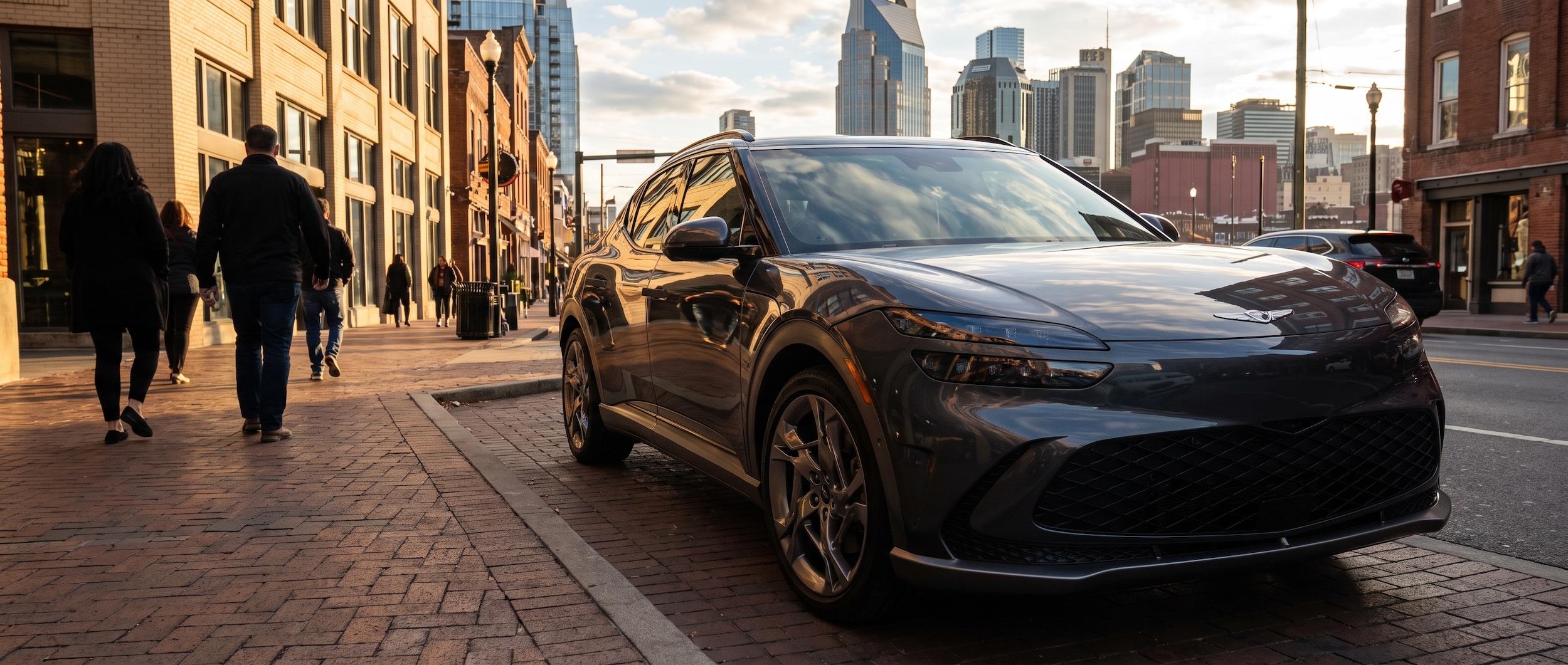
The EPA rates the 2026 GV60 at up to 306A 2026 Genesis GV60 in a sleek dark finish parked at a modern DC fast-charging station in a Nashville urban setting, late afternoon light, Middle Tennessee skyline visible in the background miles in its rear-wheel-drive Standard trim (84 kWh battery, 225 hp), while the 2026 IONIQ 5 tops out at 318 miles EPA-estimated on its long-range RWD trims. That 12-mile gap on paper shrinks to a non-issue for most Nashville-area driving, given that the average round-trip commute in this metro sits well below 60 miles, but the gap starts to matter on longer runs to Chattanooga, Knoxville, or the Smoky Mountains.
| Configuration | EPA Range | DC Fast Peak | 10-80% Time | Cargo (seats up) |
|---|---|---|---|---|
| GV60 Standard RWD | 306 mi | 350 kW capable | ~18 min | 24 cu ft |
| GV60 AWD | 282 mi | 350 kW capable | ~18 min | 24 cu ft |
| GV60 Advanced AWD | 267 mi | 350 kW capable | ~18 min | 24 cu ft |
| GV60 Performance AWD | 252 mi | 350 kW capable | ~18 min | 24 cu ft |
| IONIQ 5 Long-Range RWD | 318 mi | 350 kW capable | ~20 min | 26 cu ft |
| IONIQ 5 Long-Range AWD | 290 mi | 350 kW capable | ~20 min | 26 cu ft |
*EPA estimates. Genesis lists the 84 kWh GV60 charging 10% to 80% in approximately 18 minutes on a 350 kW DC fast charger. Hyundai lists approximately 20 minutes for the IONIQ 5 on comparable hardware. Actual results vary with battery temperature, charger availability, and ambient conditions.*
The GV60's coupe-style roofline is the direct design reason its cargo hold measures 24 cubic feet (seats up) versus the IONIQ 5's 26 cubic feet, and the IONIQ 5's squarer tailgate opening loads more easily when you're working with strollers, gear bags, or anything larger than a weekender. We think that physical difference is worth knowing before you decide.
What neither number tells you: both cars include a heat pump as standard equipment, which meaningfully reduces range loss in cold weather. Nashville winters are mild but not trivial, since January temperatures can drop into the 20s, and the heat pump matters for the weeks you actually feel it.
Where Do You Charge in Nashville?
Nashville's public charging network is real and growing. According to U.S. Department of Transportation data current as of June 2026, there are 341 open public charging locations in the city with 156 DC fast ports. The state's Fast Charge TN initiative has been building DC fast-charging sites along I-24, I-40, and I-65, connecting the Middle Tennessee corridor to Knoxville, Chattanooga, and points south toward Alabama, and that interstate spine matters for your road-trip calculus.
Both the GV60 and IONIQ 5 carry a native NACS port for 2026, so they plug directly into Tesla Superchargers without an adapter. That's meaningful access here: there's a well-documented Supercharger just off I-65 south of Nashville at Old Hickory Boulevard, and ChargePoint, EVgo, and Electrify America operate additional fast-charge sites across the metro.
Browse our current GV60 inventory to see which trims and configurations are available right now.
The practical split for Nashville EV owners comes down to this: roughly 80 percent of your charging happens at home on a Level 2 setup overnight, and the public network covers the rest. Metro Nashville manages more than 110 charging ports across 27 government sites, and the majority are available for public use at no charge (parking rules still apply). On a road trip, keep a routing app open and verify live charger status, because peak times on busy DC fast corridors can mean a short wait.
View pre-owned EV options if a gently used model fits your timeline better.
Print-and-go checklist before you commit to either car:
- [ ] Confirm your home has a 240V outlet or budget for a Level 2 charger installation
- [ ] Identify your nearest DC fast-charging station along your most common long-distance route (I-24, I-40, or I-65)
- [ ] Sit in the GV60's rear seat with the roofline in mind if you're taller than 6 feet or carry rear-seat passengers regularly
- [ ] Load your typical cargo into the GV60 and IONIQ 5 (24 vs. 26 cubic feet feels different in practice than on a spec sheet)
- [ ] Decide whether RWD or AWD matters for your use (Middle Tennessee winters rarely demand AWD, but it adds confidence on wet roads)
- [ ] Ask about the GV60's built-in fingerprint reader and Crystal Sphere gear selector (some buyers find these details decisive, others find them irrelevant)
- [ ] Verify which Supercharger stalls near your commute corridor are V4 if charging speed is a primary concern
Plan It This Way for Middle Tennessee
We'd offer anyone working through this choice a framework that starts with how you actually use a car, not how it tests on paper.
Choose the GV60 if you charge primarily at home, your typical drive falls within 250 miles round-trip, and you value a cabin that feels like a considered design object rather than a category entry. The 2026 GV60's refreshed 27-inch OLED instrument panel, Crystal Sphere gear selector, and available Electronically Controlled Suspension with Road Preview aren't features added to a checklist; they give the interior a coherence that buyers who sit in both cars tend to register immediately. And for buyers who want to know: the GV60 Performance AWD, with 429 horsepower and Boost Mode bursts to 483 hp, reaches 60 mph in approximately four seconds.
The IONIQ 5 makes more sense if cargo versatility is genuinely important to your daily life (two kids, a stroller, and weekend gear is the condition we see that tips it), if you want the longest EPA-rated range in the segment for regular longer-distance driving, or if you prefer a more upright and airy interior over the GV60's sportier silhouette. It's a highly capable car. We simply don't sell it, and we'd rather tell you that plainly than pretend the tradeoff doesn't exist.
Explore the GV70 if an SUV with more rear headroom and cargo room is the right fit; it's worth considering alongside the GV60 for buyers who want EV or electrified options in a larger footprint.
What we've noticed in how these conversations develop: the GV60 tends to settle the question for people who sit in both cars and feel the difference in how the cabin is resolved. The IONIQ 5 tends to win on the spreadsheet. Neither is the wrong answer. They just reflect different priorities, and knowing yours before you walk in saves everyone time.
Frequently Asked Questions
Do the GV60 and IONIQ 5 charge at the same speed?
They're very close, and the architecture underneath both cars is the same story: 800-volt platform, native NACS port, and 350 kW DC fast-charging capability for the 2026 model year. Genesis rates the 2026 GV60 at 10% to 80% in approximately 18 minutes on a 350 kW DC fast charger; Hyundai rates the IONIQ 5 at approximately 20 minutes under similar conditions. In practice, the charger you find, its rated speed, its current load, and the battery's temperature will affect your actual session more than that two-minute gap on paper.
Will Nashville's summer heat affect range on either car?
Yes, though both vehicles handle it more gracefully than earlier-generation EVs did. High ambient temperatures increase thermal management load, and sustained highway speed at 75 mph draws significantly more energy per mile than the EPA's combined-cycle test implies. For a Nashville July drive to Knoxville on I-40 (roughly 180 miles), either car handles it comfortably on a single charge with range to spare; plan for a DC fast stop on the return leg if you want to arrive home with comfortable reserve. The GV60's standard heat pump manages both heating and cooling efficiency, and the same is true of the IONIQ 5.
Is the GV60 meaningfully smaller inside than the IONIQ 5?
Behind the rear seats, yes. The GV60 measures 24 cubic feet versus approximately 26 cubic feet in the IONIQ 5, and the IONIQ 5's squarer hatch opening loads more easily in practice. Rear headroom is tighter in the GV60 because of its coupe-style roofline; front-seat occupants won't feel the difference, but rear passengers above roughly 5 feet 10 will notice it. Both cars have a small front trunk useful for charging cables and light items.
