
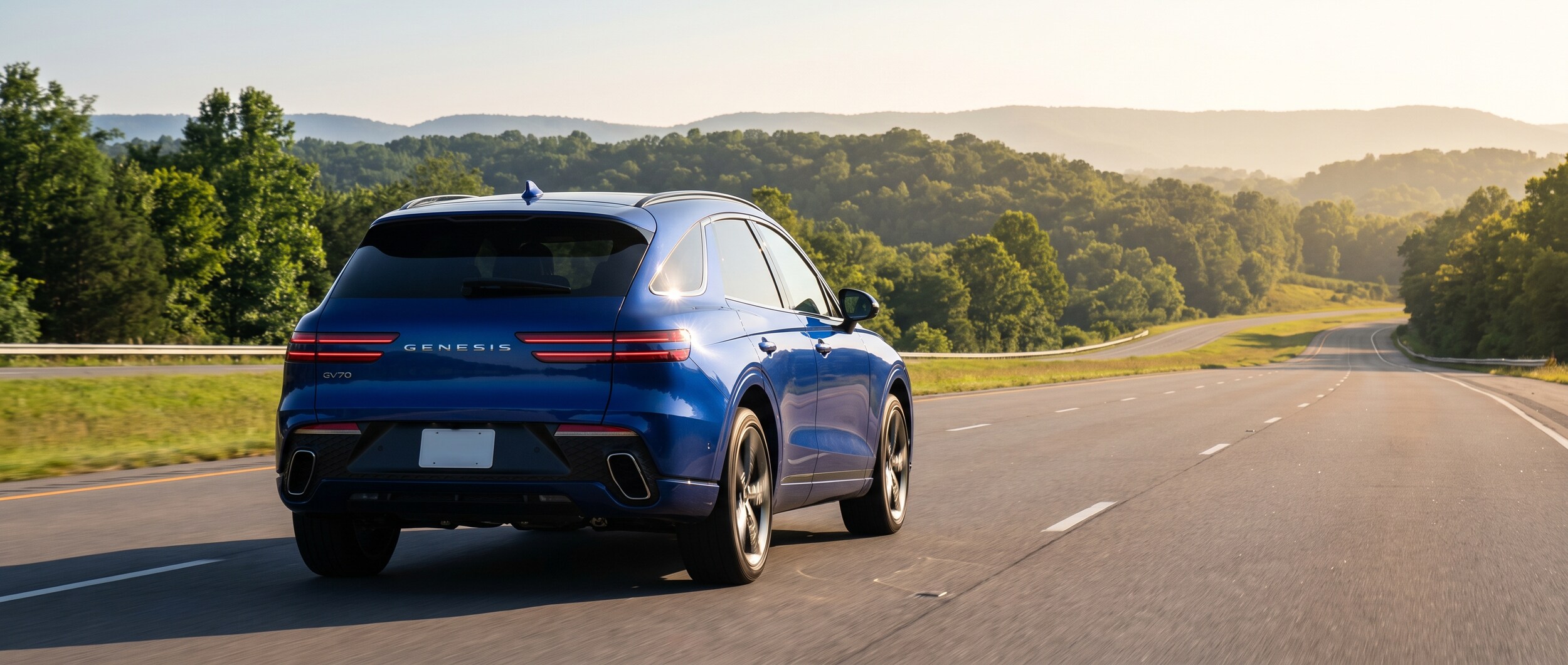
Start with the good news. The 2026 Genesis GV70 earned a five-star overall safety rating from NHTSA and a 2026 IIHS TOP SAFETY PICK+ designation, and every trim ships with a meaningful standard safety suite. Meaningful doesn't mean identical across the lineup, though. The features that carry the most weight on a July I-40 run from Nashville toward Knoxville are different from the ones you lean on in a Nashville parking garage. If you're planning that drive and wondering which trim earns its keep on the road, this breakdown is for you.
Browse our 2026 GV70 inventory to see current trims and availability.
What Does Each Trim Actually Give You?
The GV70 spreads its safety and driver-assist features across two powertrains (the 300-horsepower 2.5T and the 375-horsepower 3.5T) and several packages, and for a road-trip context the meaningful dividing lines land at three points, the base 2.5T, the 2.5T Advanced, and the 3.5T Sport Prestige. Here's each tier, without the brochure language.
| Trim | Standard Safety Suite | What's Added | Road-Trip Relevance |
|---|---|---|---|
| 2.5T AWD (base) | Forward Collision-Avoidance Assist, Blind-Spot Collision-Avoidance Assist, Lane-Keeping Assist, Lane Following Assist, Rear Cross-Traffic Collision-Avoidance, Driver Attention Warning | Nothing added at this tier | Solid highway foundation; HDA active; no Blind-Spot View Monitor camera feed or advanced rear occupant alert |
| 2.5T Select | Same as base | Wireless phone charger, cabin trim upgrades | No change to safety tier; identical driver-assist features to base |
| 2.5T Advanced AWD | Everything above | Blind-Spot View Monitor (live camera in cluster), side parking distance warning, Reverse Parking Collision-Avoidance Assist, Advanced Rear Occupant Alert (radar), surround-view monitor, ventilated seats, heated steering wheel | The meaningful jump for highway drivers: the Blind-Spot View Monitor is the feature we'd call the road-trip differentiator |
| 2.5T Sport Prestige | Everything above | Remote Smart Parking Assist 2 (perpendicular, parallel, diagonal), Genesis Digital Key 2, Electronically Controlled Suspension | Adds the adaptive suspension that reads the road ahead via camera; less about safety, more about sustained comfort on long hauls |
| 3.5T Sport Prestige | Full catalog | 375 hp, every assist feature available | For drivers who want the complete stack and the V6's highway passing power in one package |
One honest note. The 2.5T and 2.5T Select share the same driver-assist specification, so if your reason for stepping up is safety tech, the Select doesn't move the needle. The Advanced does.
Why I-40 in July Tests a Safety Suite Differently Than Daily Commuting
I-40 east of Nashville isn't a casual freeway, and summer makes that plainer than any other season, with active work zones, the plateau grade west of Cookeville, and sudden afternoon thunderstorms all stacking onto the same corridor a Nashville family drives toward Knoxville. The TDOT I-40 reconstruction project introduced active work zones beginning in spring 2026, with construction running through fall 2027 in multiple corridor segments. Summer daytime lane closures and shifting speed zones are the norm, not the exception. There's the plateau grade west of Cookeville, too, where trucks slow and traffic stacks. And mid-afternoon in July brings the kind of thunderstorm that turns the road surface briefly opaque, tests forward-collision response times, and makes lane markings harder to read.
These aren't hypothetical scenarios. They're the conditions a Nashville family faces heading toward Knoxville or the Smokies on a summer Saturday.
See our current GV70 availability to find a trim that fits how you drive this route.
Four systems in the GV70 are doing real work in these conditions.
Forward Collision-Avoidance Assist (FCA): Every trim ships with this one. It detects vehicles, pedestrians, and cyclists in your path and applies braking when the gap closes dangerously. In a construction-zone speed reduction, where the car ahead might brake suddenly at a shifted merge point, FCA is working every mile.
Highway Driving Assist (HDA) with hands-on detection: Standard across all trims for 2026, and it earns its place. HDA maintains lane centering and manages following distance using Smart Cruise Control. The 2026 update added steering wheel hands-on detection, which means the system actively confirms you're engaged rather than just detecting hand position. On a 180-mile run, that distinction matters.
Driver Attention Warning: Monitors driving patterns and alerts you when the system detects fatigue signatures. July heat, a long lunch stop, and four hours of I-40 are the conditions that put driver fatigue in play. This feature rarely gets mentioned in comparisons, and we think it earns more credit than it gets.
Blind-Spot View Monitor (Advanced and above): The tier split matters most here, on a highway thick with truck traffic. When you activate the turn signal, a live camera feed of that blind zone appears directly in the instrument cluster. Merging around a semi in a construction-zone lane shift, wanting a camera confirmation before you commit rather than trusting a warning light, is a specific benefit of stepping to the Advanced.
The Smart Choice for This Specific Drive
The GV70's safety architecture is well-sorted at the base level, and NHTSA confirmed it with a five-star overall rating, so the question isn't whether the base GV70 is safe but whether that base feature set is optimized for the specific demands of I-40 summer driving. Real driving decides that, not a rating sheet.
Our honest read. If your road-trip use is regular and your route runs through active construction and heavy-truck corridors, the 2.5T Advanced is where the safety equipment aligns with the conditions. The Blind-Spot View Monitor alone changes how confidently you manage a merge. The Advanced Rear Occupant Alert adds meaningful peace of mind if children are on board. None of that is an aspirational upgrade.
The 2.5T base is the right answer if your driving is primarily Nashville commuting with occasional highway use and you want the GV70's composed ride and standard HDA without stepping further into the lineup. We'd tell you that directly on the lot.
At no trim does the GV70 hand you a manual gearbox option or a true performance suspension tune. It isn't pretending to be that vehicle. The GV70 is a precision-built compact luxury SUV with a measured, planted character that happens to carry a highway safety suite capable of making a 180-mile July drive low-stress, most days.
The GV80 is the right conversation if your priority is third-row space or a larger footprint for bigger family road trips. The G80 sedan fits a different use case, rear-seat comfort and a quieter cabin register over cargo flexibility. If the GV70's dimensions are right for your family, the Advanced trim is the version we'd point you to for I-40 conditions.
Frequently Asked Questions
Does the GV70's Highway Driving Assist work through construction zones with shifting speed limits?
Highway Driving Assist uses Smart Cruise Control, which means it maintains a set following distance and lane position at the speed you've selected. In a zone where the speed limit drops suddenly, the system won't automatically detect a posted sign and reduce speed on its own. You'll need to adjust your set speed manually, which is a real and worth-knowing limitation. What HDA does well is reduce the micro-corrections and following-distance management that create fatigue over long stretches between those adjustments.
Is the 2026 GV70's standard safety package enough for regular I-40 road trips, or does upgrading to Advanced make a real difference?
The standard package is genuinely capable. NHTSA's five-star overall rating applies to the full GV70 lineup, not just the upper trims. For a buyer whose primary use is Nashville commuting with occasional highway runs, the base 2.5T covers the core safety cases well. The Advanced trim becomes the clear choice when you're regularly managing heavy truck traffic and lane changes at highway speeds, because the Blind-Spot View Monitor in the instrument cluster gives you a camera confirmation in addition to the warning system. It's the difference between an alert and a visual.
