
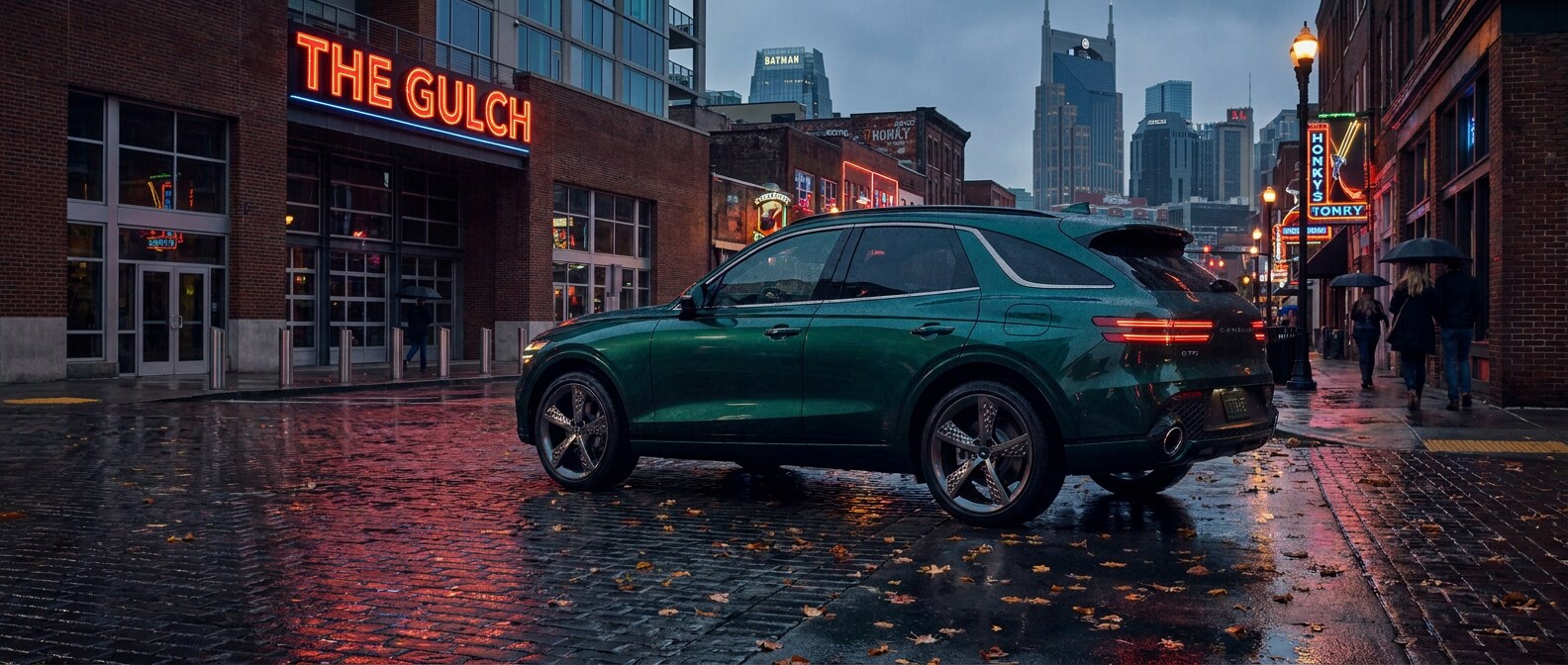
Want more standard power, a richer base cabin, and a vehicle that qualifies for a meaningful Section 179 deduction before December 31? For most Nashville buyers right now, the 2026 Genesis GV70 is the more considered choice. The 2026 BMW X3 earns its place for drivers who genuinely prioritize cargo flexibility and efficiency in one package. Neither is a wrong call. But they're not the same call.
- The 2026 GV70 opens with 300 hp standard (the base X3 offers 255 hp); the GV70's 3.5T twin-turbo V6 reaches 375 hp.
- The X3 carries more cargo with seats folded: 67.1 cu ft vs. the GV70's 56.9 cu ft, per their respective specs.
- The GV70's GVWR of 5,500 lbs may qualify business owners for Section 179 treatment before December 31; your tax advisor confirms the specifics.
- The GV70 earns an NHTSA 5-star overall safety rating and an IIHS Top Safety Pick+ designation for 2026.
- If you haul gear or need AWD composure for a Middle Tennessee winter commute, the GV70's standard HTRAC all-wheel drive and 3,500-lb tow rating are the practical choice. The X3 also comes standard with AWD.
- Year-end timing can work in a buyer's favor on both vehicles; asking our team what's currently on our lot is the fastest way to know what's available before the calendar flips.
What's the Real Difference Between These Two SUVs?
These two look like they're chasing the same buyer, and on the showroom floor they nearly are, yet the GV70 and the X3 split the compact luxury segment in ways that only show up once you're living with either one, long after the sticker stops mattering. The gap runs deeper than the badge.
| Spec | 2026 Genesis GV70 (2.5T) | 2026 BMW X3 (xDrive30) |
|---|---|---|
| Engine | 2.5L Turbo I-4 | 2.0L Turbo I-4 (48V mild hybrid) |
| Horsepower | 300 hp | 255 hp |
| Torque | 311 lb-ft | 295 lb-ft |
| Drivetrain | HTRAC AWD (standard) | xDrive AWD (standard) |
| Cargo (seats up) | 28.9 cu ft | 31.5 cu ft |
| Cargo (seats folded) | 56.9 cu ft | 67.1 cu ft |
| EPA Combined MPG | 20 city / 28 hwy (2.5T, per EPA) | 27 city / 33 hwy (xDrive30, per EPA) |
| Tow Rating | 3,500 lbs | 4,000 lbs (xDrive30) |
| GVWR | 5,500 lbs | Not verified |
| NHTSA Overall | 5-star | Not confirmed in this research |
| IIHS Award | Top Safety Pick+ | Not confirmed in this research |
| 0-60 (base) | Not published by Genesis | 6.0 sec (BMW-estimated) |
At the base trim, the GV70 wins on power. The X3 takes fuel efficiency and maximum cargo volume. Those two facts sort a lot of buyers before anyone turns a key.
Does the Year-End Timing Actually Change the Decision?
For Nashville buyers with a December 31 deadline in mind, year-end timing can genuinely change the math, and the reason is the GV70's GVWR of 5,500 lbs, confirmed in Genesis's published specs, which puts it in the IRS heavy-SUV category for Section 179 purposes. Business owners who place a qualifying vehicle in service before December 31, 2026, may be able to apply a substantial Section 179 deduction that applies to heavy SUVs in this weight class. The vehicle must be in service, titled, and used for business before midnight on the 31st. Your tax advisor is the right person to confirm whether your specific situation qualifies.
None of that is a minor footnote. The question lands with the healthcare professionals, contractors, and finance folks who make up a real part of the Nashville luxury-SUV buyer. The Genesis GV80 is worth knowing about here too. Its larger platform carries similar GVWR considerations, and for buyers who need three rows or additional rear comfort, it belongs in the same year-end conversation.
If the year-end angle doesn't apply to your situation, that's fine. The GV70 still stands on its own merits against the X3 as a daily driver. But knowing the GVWR distinction before December 31 is one of those things we'd rather you hear from us than discover in January.
For a clear look at what's currently on our lot, browsing current GV70 inventory is the most direct route.
Explore Financing Options Before Year-End
Power and Ride Character: Where the Engines Tell Different Stories
The 2026 GV70's standard 2.5-liter turbo four makes 300 hp and 311 lb-ft, routed through an eight-speed automatic to standard HTRAC all-wheel drive, while the 2026 X3 xDrive30 opens at 255 hp and 295 lb-ft from a 2.0-liter four with 48-volt mild-hybrid assistance. That gap is real on an on-ramp, and it's especially noticeable in the GV70's Sport drive mode, which sharpens throttle response from the same engine.
Both vehicles offer a more muscular option up the range. The GV70 3.5T's twin-turbo V6 produces 375 hp and 391 lb-ft of torque. The X3 M50 matches that with a 393-hp, 428-lb-ft turbocharged inline-six and a BMW-estimated 4.4-second 0-to-60 time. Those two versions raise a different kind of question. How much performance register do you actually want in a family SUV you're driving on I-65 in December?
For Middle Tennessee winters, both vehicles run standard AWD, and the GV70's HTRAC system includes terrain modes (Comfort, Eco, Sport, Snow, and Individual on the 2.5T) that earn their keep when Nashville gets an ice event in January. That's a real consideration for anyone commuting from Brentwood or making regular runs on I-24 toward Murfreesboro when the weather turns.
| Option | GV70 | BMW X3 |
|---|---|---|
| Pros | Standard 300 hp, terrain modes, 5-star NHTSA, IIHS TSP+, richer base interior | Larger max cargo volume, better base MPG, mild-hybrid efficiency, 4,000-lb tow |
| Cons | Lower MPG at base (20 city/28 hwy vs. 27/33), smaller max cargo when folded | Lower standard HP (255 vs. 300), fewer drive mode selections confirmed at base |
Cargo, Practicality, and the Honest Trade-off
Cargo is the one category where we won't pretend the GV70 wins, because seats folded flat, the X3 delivers 67.1 cu ft of maximum cargo volume against the GV70's 56.9 cu ft, a meaningful gap if you're running gear for a business or hauling larger items often. With seats up, it's much closer, 28.9 cu ft for the GV70 against 31.5 cu ft in the X3.
For most five-passenger daily use, the GV70's 28.9 cu ft is practical. Groceries, luggage for two, a stroller, it handles all of that without drama. Where the X3 pulls ahead is in the specific scenario where seats-folded capacity shapes what a vehicle can do for you. If that's your routine, the X3 is the honest answer. We'd rather tell you that clearly than have you discover it loading for a weekend trip.
The GV70 compensates with a 3,500-lb tow rating, and the base X3 xDrive30 is rated at 4,000 lbs per BMW. For Nashville buyers who pull a small boat or a loaded utility trailer to a property in the Cumberland Plateau or down toward Center Hill Lake, both are capable. The GV70's tow rating is real and usable; it's not a footnote.
So Which One Should You Choose?
Pick the 2026 GV70 if:
- You want more standard power without stepping into the top-tier engine. The 300-hp 2.5T is genuinely quick and costs less than the X3 M50 for comparable performance feel.
- You run a business and want to place a 5,500-lb-GVWR vehicle in service before December 31 for Section 179 purposes. Confirm with your tax advisor.
- Interior refinement at the base trim matters to you. The GV70's standard features and material quality are well-regarded relative to its price point.
- Safety documentation matters. The NHTSA 5-star overall rating and IIHS Top Safety Pick+ are confirmed for the 2026 model year.
Pick the 2026 BMW X3 if:
- Maximum cargo volume is your deciding factor and you regularly use the flat-folded floor. At 67.1 cu ft, it's notably larger than the GV70's 56.9.
- Fuel efficiency is a genuine priority. The X3 xDrive30's EPA-rated 29 mpg combined is meaningfully better than the GV70 2.5T's 20 city / 28 hwy.
- You want the BMW driving character and iDrive 9 interface specifically. That's a fair reason, and it's not abstract.
- The X3 M50's 393-hp inline-six is what you're after. It's the more powerful option at the top of this segment.
The honest frame for a Nashville year-end shopper comes down to this. The GV70's combination of standard power, confirmed safety credentials, GVWR tax positioning, and refined base cabin is the stronger case for the majority of buyers in this market right now. The X3 is not a lesser vehicle. A different set of priorities drives it. Find out what your current vehicle is worth before the year closes. That conversation is worth having before December gets busy.
Frequently Asked Questions
Does the 2026 Genesis GV70 come with all-wheel drive as standard?
Yes. The 2026 GV70 comes with Genesis's HTRAC full-time all-wheel drive as standard across the lineup. It includes selectable terrain modes (Comfort, Eco, Sport, Snow, and Individual on the 2.5T configuration) that adjust throttle mapping and traction behavior for different road conditions. For Nashville winters, where ice events are intermittent but meaningful, that standard AWD configuration is worth noting.
Is the 2026 GV70 or the 2026 BMW X3 better for a business owner thinking about year-end taxes?
The 2026 GV70 carries a published GVWR of 5,500 lbs, which places it in the IRS heavy-SUV category. For tax year 2026, the IRS Section 179 cap for SUVs in that weight class allows a substantial deduction. That's a real consideration for a business owner placing the vehicle in service by December 31. The X3's GVWR is not something we're able to confirm independently here, so we'd recommend checking directly with BMW or your tax advisor for that vehicle. Either way, your accountant should be in the conversation before you rely on any deduction: the percentage of business use, how the vehicle is titled, and other factors all shape the final number.
