
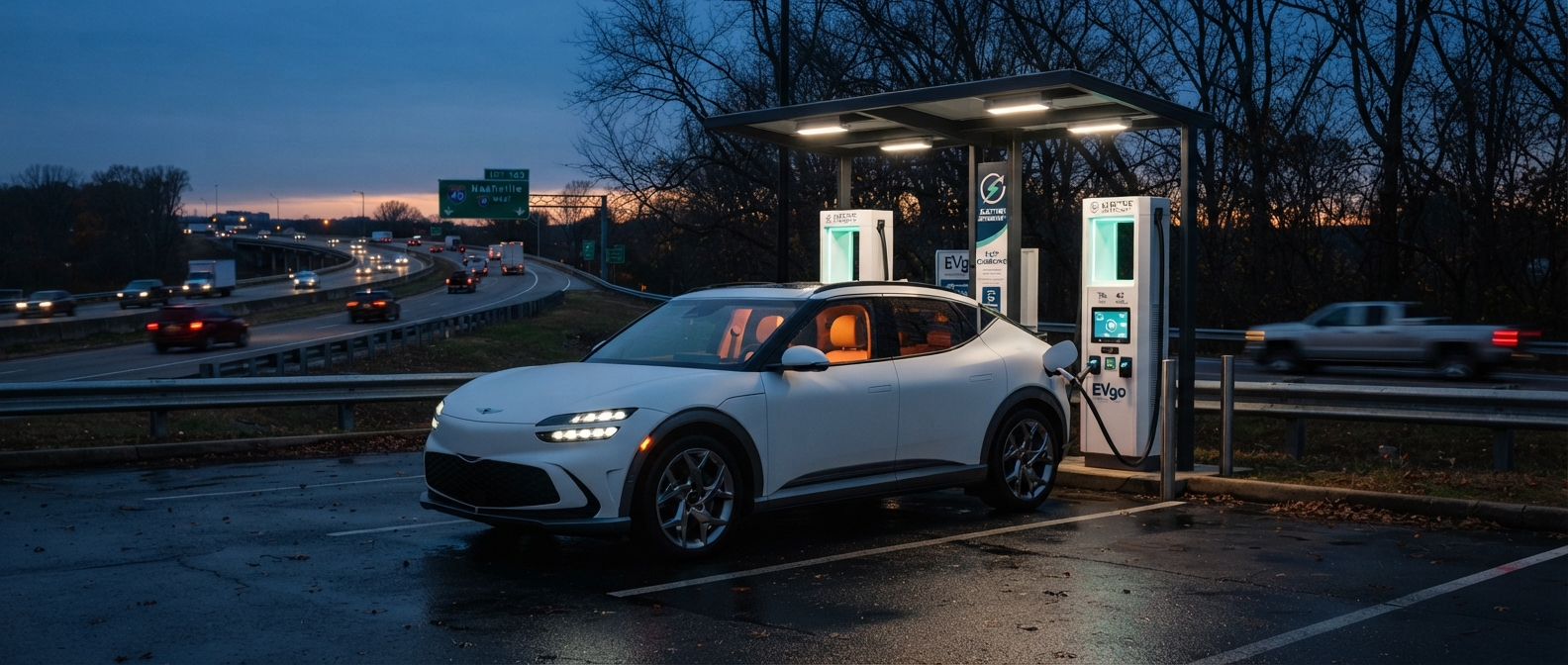
We'll give you the straight version. The 2026 Genesis GV60 is a genuinely capable road-trip vehicle, with an EPA-estimated range of up to 306 miles and an 800-volt architecture that can recover 10% to 80% of its battery in approximately 18 minutes at a 350 kW DC fast charger. Put those two numbers together and the math on holiday travel really does shift. What they don't change is the physics. Cold air and highway speeds cost range, and a November drive to visit family is usually both. Plan around verified figures instead of best-case ones, and the GV60 handles the trip with very few compromises.
How Far Will the GV60 Really Go on a Holiday Drive?
The GV60 will cover most Tennessee holiday routes on a single charge, though the working number you should plan around sits below the window sticker, because EPA range shifts with trim and drivetrain, and a cold highway cruise trims it further still, so the figure that matters is the one measured against your configuration and the weather.
| Trim | Drivetrain | EPA-Estimated Range | DC Charge Rate (peak) |
|---|---|---|---|
| Standard | RWD, 225 hp | 306 miles | Up to 350 kW |
| Advanced (19" wheels) | AWD, 314 hp | 282 miles | Up to 350 kW |
| Advanced (20" wheels) | AWD, 314 hp | 267 miles | Up to 350 kW |
| Performance | AWD, 429 hp | 252 miles | Up to 350 kW |
All four trims share the same 84 kWh battery and 800-volt architecture. The range gaps come from wheel size and drivetrain, not battery capacity. Genesis lists the Standard RWD at 306 miles EPA-estimated; the Performance AWD lands at 252 miles EPA-estimated. Those get measured under controlled conditions.
A sustained highway cruise at 70-75 mph in November tells a different story. Cold batteries are less efficient because internal resistance climbs at lower temperatures, and the cabin heater pulls straight from the same pack that moves the car. AAA testing has found that heater use at 20 degrees Fahrenheit can cut EV range by as much as 41% against the rated figure. Nashville's November average low sits in the upper 30s to low 40s Fahrenheit, a milder cold penalty than a northern climate, though it's still real. Plan on something closer to 70-80% of your EPA figure as a working highway range in cool weather. For the Standard RWD, that's about 215 to 245 miles between stops on a November run. For the Performance AWD, plan on 175 to 200 miles.
The cushion stays comfortable for most Tennessee holiday routes. Planning is the step that matters.
Where Do You Charge Around Nashville and Along the Major Corridors?
Browse our current GV60 inventory to see which trim is on hand, then think through your corridor, because Nashville sits at a genuine crossroads for I-65, I-24, and I-40, and the charging network along all three has matured considerably over the past few years.
Within Nashville. The Tesla Supercharger at 61 E. Thompson Lane in South Nashville, 37211, runs 24 stalls at up to 250 kW and welcomes NACS-equipped vehicles, which every 2026 GV60 is from the factory. That location sits about two miles from our store. For a GV60 owner in this part of the city, it's the most convenient fast-charge option going.
I-65 south toward Huntsville and Birmingham. Supercharger nodes at Brentwood and further south along the I-65 corridor keep the route covered. The 2026 GV60's standard NACS port means you won't need an adapter.
I-24 east toward Chattanooga and Atlanta. This corridor includes a Supercharger at Monteagle on the plateau. The climb from the valley floor up to Monteagle is sustained, and grades pull real range, so starting that segment with a higher state of charge than you'd plan for flat ground makes sense. There's a Supercharger in Murfreesboro too, which makes a logical pre-climb top-up point.
I-40 east toward Knoxville. A Supercharger in Crossville sits near the mid-corridor mark. Tennessee's statewide fast-charging network now includes 184 stations with more than 1,000 stalls. Coverage on the main corridors out of Nashville is solid.
Explore financing options if you're still deciding between trims and weighing the range tradeoffs above.
Smart stops for a Nashville holiday traveler
- Set your destination in the GV60's navigation before you leave; the system routes charging stops automatically and switches on battery preconditioning as you approach each one
- Use the Thompson Lane Supercharger as a departure top-up point if you're heading south or east and want to leave with a full pack
- On I-24 east, treat Murfreesboro as an optional early stop rather than a required one, unless temperatures sit below freezing and you've run the heater hard
- Arrive at chargers at 10-20% state of charge rather than lower; the GV60's 800V architecture accepts charge fastest in that window, and the auto-preconditioning system warms the battery ahead of arrival to hold full charging speed even in cool weather
- Heated seats draw meaningfully less energy than the cabin air heater, so lean on them to stay comfortable and supplement rather than replace the heater on colder runs
Planning It This Way: The Workflow That Actually Works
Cold-weather range planning for the GV60 sounds complicated the first time out, yet most of the work happens on its own, and once you tell the car where you're going it preconditions the battery and routes the stops for you, which leaves you a short list of habits to handle the rest.
Set a fast charger as your navigation destination. The GV60 begins battery preconditioning on its own the moment a DC fast charger goes in as the nav target. A preconditioned battery reaches the charger closer to its ideal operating temperature, so it accepts energy at or near full speed instead of starting slow and ramping up. On a cool November morning, this is the single most useful thing you can do before a highway run.
Leave home with a full battery, not an 80% battery. For daily commuting, stopping at 80% helps battery longevity. For a holiday leg that starts in the low 40s Fahrenheit and runs 200-plus miles, start at 100%.
Accept one planned stop. On a Nashville-to-Birmingham run of about 190 miles, the Standard RWD can make it in one shot in mild weather. Add a 25-minute stop anyway. You'll arrive relaxed instead of watching the range display, and the GV60's 18-minute 10-to-80% window on a 350 kW station means you'll give up less time than a gas-car fill-up and a coffee line combined.
Park inside at your destination if possible. An unheated garage keeps the battery 15-20 degrees Fahrenheit warmer than outdoor overnight parking. A warmer battery on departure morning needs less energy for thermal management, which shows up as more range from the moment you pull out. On the frosty mornings we get here, that difference is easy to feel in the first few miles.
One tradeoff deserves naming plainly. An AWD Performance GV60 owner heading to Asheville in 25 degrees Fahrenheit weather with the heat running should plan for 170-190 miles of effective range per leg. None of that is a failure of the car. The number is simple physics, and planning around it turns a potential anxiety point into a minor inconvenience. Our service team can confirm your battery health and charging system before a long run if it's been a while.
Frequently Asked Questions
Does the 2026 GV60's 18-minute DC charge time still apply in cold weather?
It depends on whether the battery is preconditioned. A cold, unpreconditioned battery reaches a charger with elevated internal resistance, which slows the initial charge rate noticeably. The 2026 GV60 handles this by warming the battery on its own when you set a DC fast charger as your navigation destination. With the battery properly preconditioned and a 350 kW/800V charger on hand, the 18-minute 10-to-80% session is realistic. At a 400V Supercharger, plan on 20-25 minutes. Cold ambient air slows the session at any charger to some degree, though the auto-preconditioning system closes most of that gap.
How much range does the GV60 actually lose on a cold highway run?
The working answer is 15-25% below the EPA figure on a sustained highway cruise in the low 40s Fahrenheit, with the heater running at a comfortable level. AAA testing at 20 degrees Fahrenheit with active cabin heating showed losses as high as 41% for EVs generally. Nashville's November temperatures run milder than that, so our working planning figure for the GV60 Standard RWD is about 215 to 245 miles per leg rather than the full 306. That figure assumes highway speeds around 70 mph, the heater in use, and no cabin preconditioning while you're still plugged in at home. Precondition the cabin before you leave and the number improves, because the heater has less work to do from the first mile.
Can the 2026 GV60 charge at Tesla Superchargers without an adapter?
Yes, it can. The 2026 GV60 ships with a native NACS port, the same connector Tesla Superchargers use, so you won't need an adapter. At 800V-compatible Supercharger hardware, the GV60 charges at or near its full 350 kW peak rate. At older 400V Supercharger stalls, peak charge rate typically runs 100-150 kW, which stretches the 10-to-80% window to around 20-25 minutes. Both work. The Thompson Lane Supercharger in South Nashville, two miles from our store, is confirmed NACS-compatible and open 24/7.
