
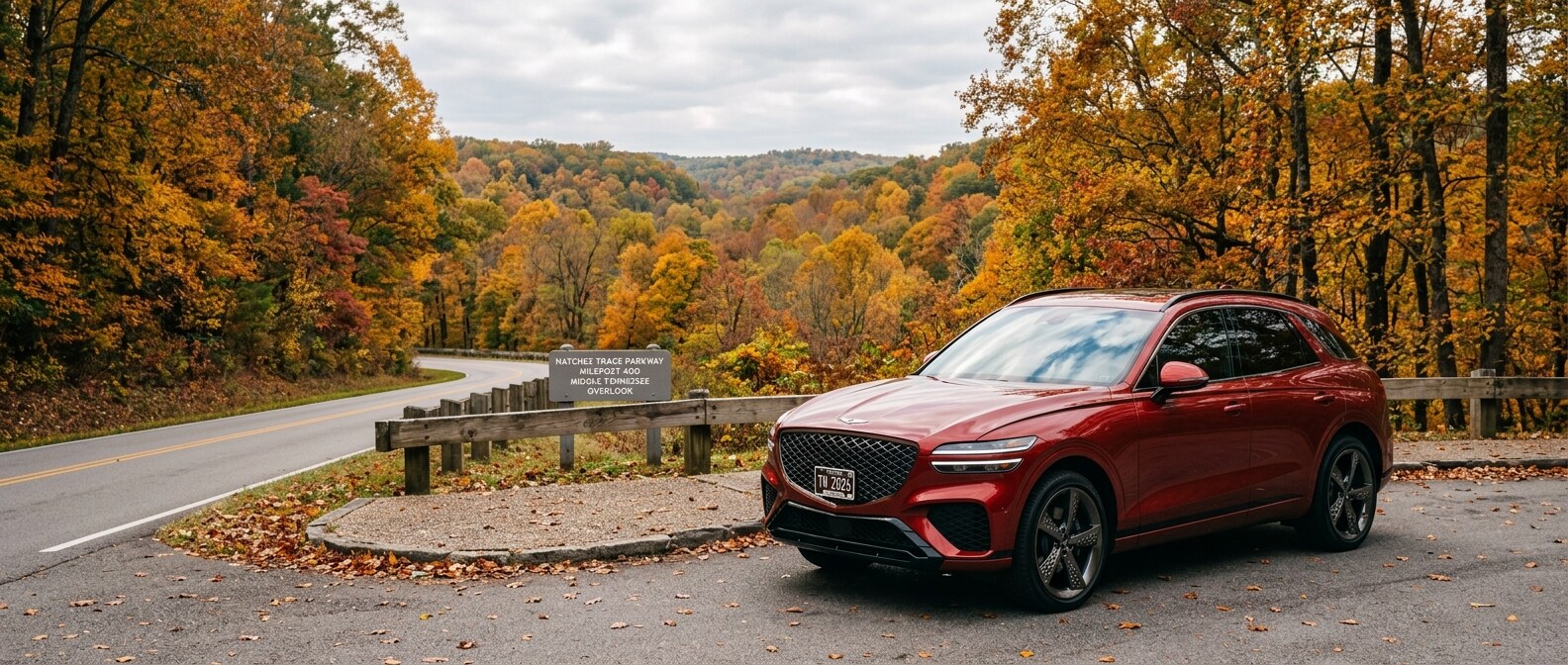
The Natchez Trace Parkway enters from Tennessee Highway 100 just southwest of Nashville, runs a posted 50 mph through 444 uninterrupted miles of canopy, and hits peak color in Middle Tennessee from mid-October through early November. No stoplights. No commercial trucks. No billboards. What it offers instead is smooth pavement, long curves, and the kind of rolling hardwood color that makes you want a cabin worthy of the view outside it.
The 2026 GV70 is on our lot right now, and it's the first model we reach for when the plan involves a day on the Trace. The question worth asking, though, is whether the drivetrain choice changes anything on a road like this. It does. Let's walk through it.
How Does AWD Actually Work on a Genesis?
Across the 2026 Genesis lineup, the AWD system is a torque-vectoring, on-demand setup that drives the rear wheels in calm, dry conditions and sends torque forward only when sensors catch slip at the rear or anticipate reduced traction. So it isn't the always-active, 50/50-split AWD you'll find on some older truck-based platforms. It runs lighter, sips less fuel, and keeps that rear-drive character when grip is plentiful.
That distinction matters on the Natchez Trace, where the pavement is genuinely excellent and the gradients stay gentle. AWD does its real work on overcast October mornings when dew sits on the surface until midday, and across the parkway's occasional leaf-covered pull-offs. Call it a confidence boost, nothing more dramatic than that.
| Feature | RWD (G70 2.5T base) | AWD (G70 / GV70 / GV80 / G80) |
|---|---|---|
| How it works | Rear wheels driven; front wheels unloaded | Rear-biased; front engagement on demand |
| Dry-road character | Sharper steering response, lighter feel | Marginally heavier; more planted |
| Wet-surface confidence | Requires driver awareness on cold mornings | Automatic torque redistribution forward |
| Fuel economy (EPA, 2.5T example) | 21 city / 29 hwy (G70 RWD) | 20 city / 28 hwy (G70 AWD) |
| Middle Tennessee winter relevance | Adequate for Nashville's typical winters | Reassuring on icy bridge approaches |
| Best for Natchez Trace in October | Competent (dry, smooth pavement) | Preferred for early-morning or rainy starts |
AWD on the G80 is standard across the entire lineup. Every 2026 G80 ships with it baked in.
Which Genesis Model Do You Actually Need for This Drive?
That depends on who's riding along and what you want out of the day, and the useful truth is that all four models are well-sorted for the Natchez Trace, a road that rewards composure far more than capability. None of them will leave you wanting. The differences live in the details.
The G70 is the one to grab when the drive itself is the point. The 2026 G70 2.5T delivers 300 horsepower and 311 lb-ft of torque through an 8-speed automatic, with rear-wheel drive standard and AWD available. It sits lower, steers with a precision the bigger models can't match, and the 111.6-inch wheelbase keeps it responsive through the Trace's long bends. Rear-seat room is the tradeoff. Two adults back there for a four-hour loop will feel the tighter quarters, so this one suits a couple well and a family of four less so.
The GV70 is the one that suits the broadest range of drivers. The 2026 GV70 2.5T AWD returns an EPA-estimated 20 city / 28 highway, and the raised seating position hands passengers a better view of the canopy without the bulk of the GV80. Ground clearance of 7.7 inches means a gravel overlook or a pull-off toward Leiper's Fork gives you nothing to worry about. On the Trace that counts, since the stops worth making tend to involve leaving the pavement entirely.
The GV80 changes the conversation the moment there are three rows to fill. Its optional third-row seat and longer 116.3-inch wheelbase give the cabin a quieter, more isolated feel. The 2026 GV80 2.5T AWD returns an EPA-estimated 20 city / 26 highway, and its 8.1 inches of ground clearance keep it just as unhurried on those same gravel pull-offs. One honest tradeoff remains. The GV80 carries more weight, and the Trace's gradual grades are exactly where that mass shows up in fuel consumption over a full day out.
The G80 makes the most sense when the Trace is one leg of a longer trip that begins or ends in Nashville traffic. AWD comes standard on every G80 trim. Road-scanning adaptive suspension on Sport Prestige trims reads the pavement ahead with a forward camera and adjusts damping before the car reaches the imperfection. On a smooth parkway you'll barely notice it. On the I-65 approach getting there, it earns its keep.
What This Means for Your Next Vehicle
A fall color drive turns out to be a useful frame for thinking through a vehicle purchase, because it tests the parts of a car no spec sheet lists, the cabin sound at 50 mph and the quality of the sightlines and whether the sunroof framing chops up the sky or opens it. Those are the criteria that separate a refined vehicle from a merely capable one.
Skip the agonizing, and the choice sorts itself quickly. Want the most engaging drive on the Natchez Trace? The G70 rewards you in proportion to how closely you're watching the road. Want the day to feel effortless for everyone aboard? The GV70's the better answer. AWD is worth adding if your fall drives start early or run into rain. The G80 earns its place on longer routes, where refinement compounds across hours, not miles.
We're in South Nashville. The northern terminus of the Natchez Trace sits off Highway 100, roughly 20 minutes from our address on Bell Road. Come see any of these in person, and we'll match you with the right one for how you actually drive.
Frequently Asked Questions
Is AWD necessary for fall drives near Nashville?
AWD isn't required for a dry October day on the Natchez Trace, where pavement is smooth and gradients are gradual. It earns its keep on overcast mornings when dew lingers on the surface, on shaded pull-off areas with leaf cover, and on any drive that extends into Middle Tennessee's early-winter conditions (December through February). If your fall drives tend to start before 9 a.m. or run into afternoon rain, AWD adds a meaningful layer of confidence. If you're driving the Trace on a clear October afternoon, RWD handles the road without compromise.
Which 2026 Genesis SUV has better highway fuel economy, the GV70 or the GV80?
The 2026 GV70 2.5T AWD is EPA-estimated at 20 city and 28 highway. The 2026 GV80 2.5T AWD returns 20 city and 26 highway on the same engine family. Both use the 300-horsepower 2.5-liter turbocharged inline-four paired with an 8-speed automatic. The two-mpg highway difference reflects the GV80's additional mass (the GV80's roughly 10 inches longer and sits on a 3.1-inch longer wheelbase). On a full Natchez Trace day loop, that difference is modest. The more meaningful variable is how you load the vehicle: a GV80 with a full third row typically returns less than the EPA figure.
