
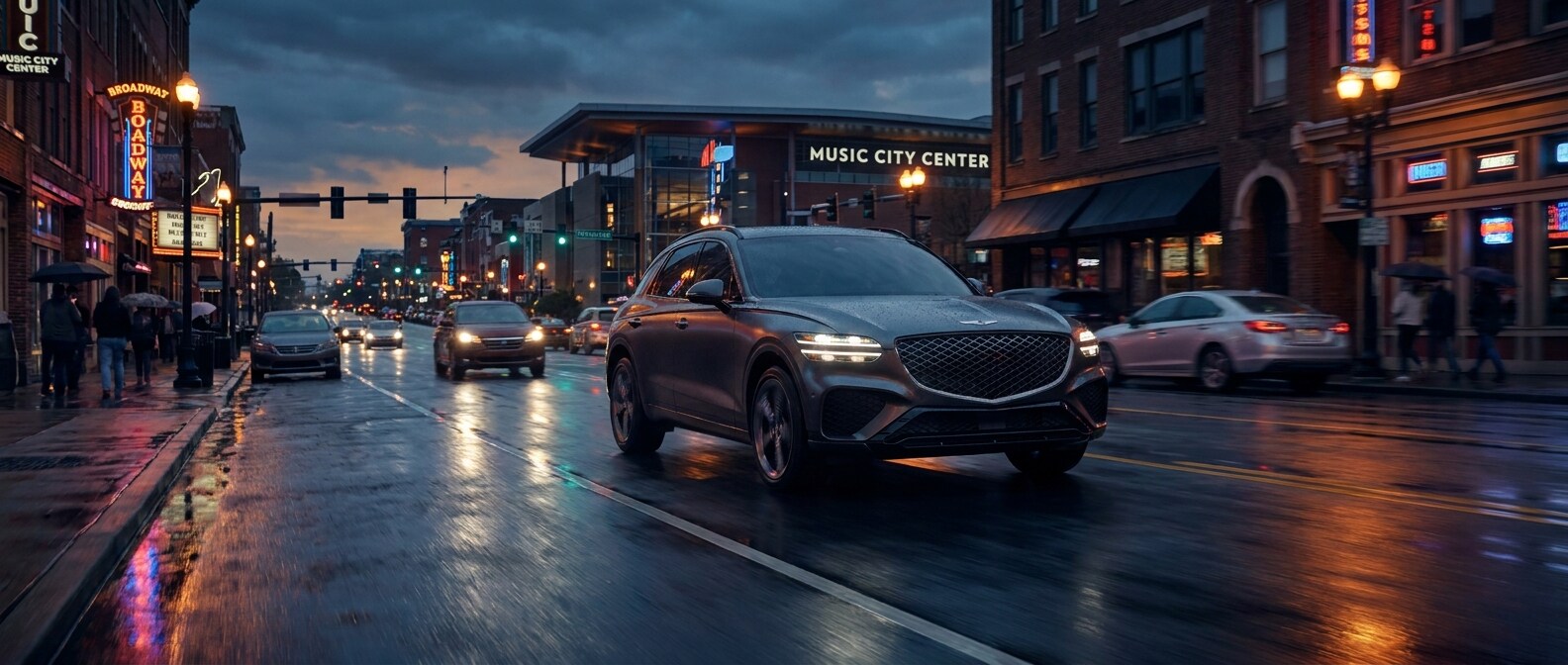
Nashville doesn't get a dry season, not really. If you're weighing the GV70 against the GV80 for South Nashville's rain-slicked streets, the AWD systems land nearly identical. What separates them is footprint, maneuverability, and how much space you genuinely need.
- Both the 2026 GV70 and GV80 come standard with AWD and hold a 5-star NHTSA overall safety rating. Traction capability is not what distinguishes them on wet roads.
- The GV70 is 185.6 inches long with a 113.2-inch wheelbase. The GV80 is 194.5 inches long on a 116.3-inch wheelbase, a meaningful size difference on a tight commercial corridor like Bell Road.
- The GV70 returns up to 20 city / 28 highway mpg (2.5T AWD). The GV80 2.5T AWD comes in at 19 city / 24 highway. On rainy Nashville commutes, that city-fuel gap adds up.
- If third-row seating or 6,000-lb towing capacity matters to you, the GV80 earns its larger footprint. If it doesn't, the GV70 is the more focused, more maneuverable choice.
- The deciding factor: be honest about how often you actually use cargo space beyond 28.9 cubic feet.
Which one wins when the rain's coming down on I-65 and you're threading the South Nashville grid? Our showroom sits right on Bell Road, so we field this one from both sides, two SUVs, same brand, same AWD, same confident Genesis face. We'll give you a real answer, not a nudge toward the pricier badge.
What's the Real Difference Between the GV70 and GV80?
Both the GV70 and GV80 share the same powertrain family, so the split between them isn't really about what sits under the hood; it shows up in size, in cargo room, and in how each one carries itself through a tight, wet-road environment like the South Nashville grid. The table below lays out what actually matters for this decision. Read it with your own driveway in mind.
| Dimension | 2026 Genesis GV70 | 2026 Genesis GV80 |
|---|---|---|
| Length | 185.6 in | 194.5 in |
| Wheelbase | 113.2 in | 116.3 in |
| Ground clearance | 7.3 in | 8.1 in |
| Cargo volume | 28.9 cu ft | 71.7 cu ft |
| Max towing (rated) | 3,500 lbs | 6,000 lbs |
| 2.5T AWD city/hwy mpg | 20 / 28 | 19 / 24 |
| 3.5T AWD city/hwy mpg | 18 / 25 | 16 / 22 |
| Seating | 5 | 5 or 7 |
| NHTSA overall safety | 5 stars | 5 stars |
| IIHS 2026 award | Top Safety Pick+ | Top Safety Pick+ |
The GV80's ground clearance advantage (8.1 in vs 7.3 in) is modest. Both are paved-surface luxury vehicles, not trail runners. What registers on a rainy Bell Road drive is the nearly 9-inch length difference, and that difference isn't abstract. Think parking lot geometry, lane-change confidence in spray and reduced visibility, and the feel of threading through the construction-zone narrowing that South Nashville seems to produce on a quarterly basis.
Does the AWD System Actually Make a Difference in Nashville Rain?
Yes, AWD earns its keep in Nashville, and both the GV70 and GV80 carry it standard across every trim, a sensible default in a metro that averages around 49 inches of rain a year by the climate records, well above the national average of 38 inches. That total spreads across about 120 rainy days a year. There's no dry season in this town. Rain-day driving isn't occasional; it's the commute.
The GV80 distributes torque electronically and tucks a Snow mode into its Terrain Mode Select system, which softens throttle mapping and shift behavior for low-grip surfaces. The GV70 runs the same reactive torque-split logic, tuned to the same end.
Both feel composed and settled when the pavement is wet. Neither hunts or wanders at highway speed through standing water.
The trade-off on the GV70 is worth naming. Its 7.3-inch ground clearance handles Nashville's surface streets fine, but it sits 0.8 inches lower than the GV80's 8.1 inches. In deep ponding, which shows up on some of the underpasses around Antioch and the lower Bell Road commercial strip after a hard spring rain, the GV80 holds a marginal edge. Marginal, though. Neither one is built to ford standing water, and we'd give you the same caution in both.
What we notice with the GV70 on wet roads is how direct its steering stays under your hands. The GV80's longer wheelbase makes it feel planted and serene on the interstate; the GV70 runs more alert, quicker to answer a sharp input. In low-visibility rain with a lot of lane changes, that responsiveness reads as confidence rather than nerves.
See Current GV70 and GV80 Offers
Cabin Tech and Visibility: How Both Perform When It's Raining Hard
Rain driving is as much about what's inside the car as what's under it, because a defogger you can reach and a screen you can read matter when visibility drops on Bell Road and your windows are fighting October humidity. Both the 2026 GV70 and GV80 picked up a significant interior refresh that bears directly on wet-weather driving.
The 2026 GV70 now carries a 27-inch OLED screen that folds the driver information display and infotainment into one wide panel, with a separate lower screen for climate controls. In practice, keeping climate on its own surface means you're not pawing through menus to find the defroster on a foggy October morning, a small thing that earns its keep when Bell Road is wet and your windows are fighting the humidity.
Both models come standard with Forward Collision-Avoidance Assist. IIHS rates the GV70's pedestrian crash prevention as Good in the 2026 cycle, the highest grade on offer. Its vehicle-to-vehicle prevention lands at Acceptable, the same result most of its direct competitors post. NHTSA hands the 2026 GV70 an overall 5-star safety rating, and the IIHS separately names it a Top Safety Pick+ for 2026.
For rear visibility in the rain, reversing into a space while water streaks the back glass, the GV80's available surround-view monitor (standard on Advanced and above trims) is a genuine advantage. The GV70 gives you parking sensors and an available rear camera, but the GV80's full surround-view system paints a more complete picture when the lot is tight and the rain is throwing glare.
Practicality on Bell Road: Cargo, Seating, and the Honest Trade-Off
Cargo is where this GV70-versus-GV80 decision stops being abstract and gets concrete, because the GV80's 71.7 cubic feet of total volume dwarfs the GV70's 28.9, and the two end up fundamentally different vehicles in terms of what you can actually load inside. We'll be plain about that.
If you regularly haul gear for youth sports, instruments (Nashville being Nashville), lumber runs, or road-trip luggage for four adults, the GV70 will feel tight, and it won't pretend otherwise. As a compact luxury SUV, it gives you 28.9 cubic feet behind the second row, roughly segment-average. The GV80's 71.7 cubic feet total with the seats folded sits in a different conversation entirely.
The third-row option on the GV80 deserves a straight read. It seats adults for shorter trips but stops being comfortable on a long haul for anyone over five-foot-eight. For occasional extra passengers, or a child seat in a pinch, it works. As a daily commuter row for grown adults, it doesn't.
Towing is where the gap reads cleanest. Genesis rates the GV70 at 3,500 pounds, which covers a small trailer, a jet ski, or a modest recreational load. The GV80 carries a 6,000-pound rating, opening up a meaningfully wider range of towable equipment. If a boat lives in your driveway, that number does the deciding.
Browse our current GV70 and GV80 inventory to compare available trims and configurations.
So Which Should You Pick?
The GV70 is the right call if your driving lives in urban and suburban Nashville, the Bell Road runs, I-65, the Nolensville Pike corridor, the parking structures, with a family that fits in five seats and reasonable cargo demands. It's nimbler in tight spaces, it returns better fuel economy (the EPA rates the 2.5T AWD GV70 at 20 city / 28 highway versus the GV80's 19 city / 24 highway), and it gives up nothing meaningful in wet-weather capability. In a city that sees rain on about 120 days a year, you want a vehicle that places itself with precision in low-visibility traffic. The GV70 is that vehicle.
The GV80 earns its size if you need the cargo volume, the towing capacity, or the occasional third row. Its longer wheelbase makes highway miles serene, and its composure at interstate speed in heavy rain is real and noticeable. The trade is that you'll feel every extra foot of length in South Nashville's parking lots. The GV80 is the right choice when your life truly requires what it carries, not as a reflex toward "more."
Our candid take, after time with both on Nashville roads, runs like this. Resist the instinct to size up just because bigger feels like more. The GV70 is the more focused option, not just the smaller one. For most single-driver and family-of-four buyers running South Nashville commutes, it's the one that feels better every single day.
Frequently Asked Questions
Does the 2026 Genesis GV70 come with AWD standard?
Yes. AWD is standard on every 2026 GV70 trim. There is no rear-wheel-drive configuration available for the GV70. Both the 2.5T and 3.5T powertrains deliver torque to all four wheels through an electronically controlled system that redistributes grip in low-traction conditions, including wet pavement.
Is the GV70 or GV80 better for rainy Nashville driving?
Both are competent in wet conditions. NHTSA gives each model a 5-star overall safety rating, and the IIHS awarded both the 2026 Top Safety Pick+ designation. The meaningful difference is footprint. Nashville's surface-street grid, including the Bell Road commercial corridor, rewards a vehicle that's easy to place in a lane and quick to park under pressure. The GV70, at 185.6 inches, is roughly 9 inches shorter than the GV80 and has a tighter turning diameter. For daily urban and suburban driving in a city that averages about 49 inches of rain annually, the GV70's size and steering precision are an advantage. The GV80 is the better choice when cargo volume. 71.7 total cubic feet, or 6,000-pound towing capacity is a genuine need.
