
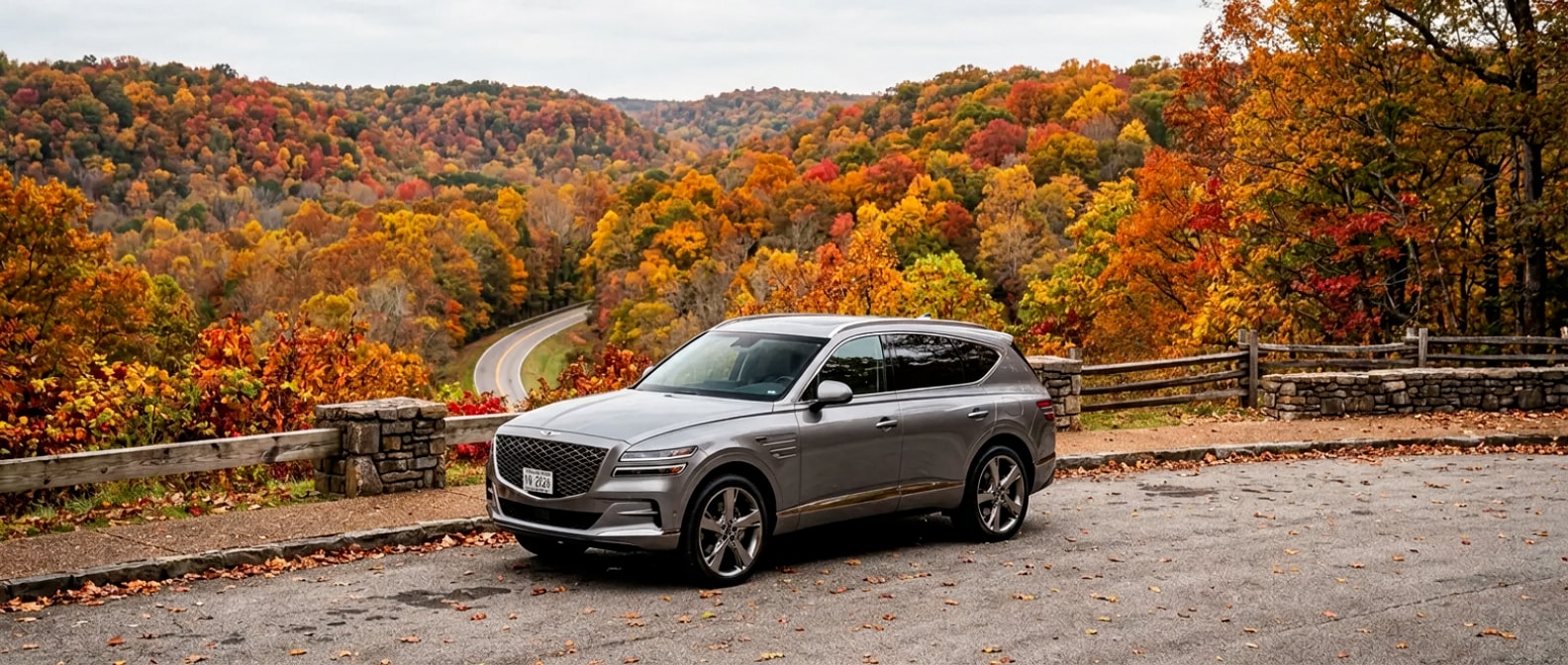
Out on Nashville's west side, the Natchez Trace Parkway's northern terminus sits at Milepost 442.1, just off Tennessee State Route 100. Plan a half-day from Bell Road and you're on the pavement within 20 minutes. The 2026 GV80 is composed, unhurried, and built with specific engineering choices that make a 50-mph two-lane road more rewarding, not less.
None of this is a sports car run. The point of a drive like this is the light through Tennessee hardwoods in October, a Federal-era grave site in a grove of cedars, and a waterfall you'll nearly miss if you're not watching for the pullout sign. The GV80 supports that kind of attention. It doesn't demand it for itself.
What's the Plan at a Glance?
The stops below make up a half-day loop you can reach straight from Nashville's west side, which keeps the logistics simple, though you could stretch any one of them into a full day if the light and the overlooks pull you in. All milepost markers follow the National Park Service designation. Drive the Trace southbound from the northern terminus; entry and driving are free.
| Stop | What to Do | Best Time to Visit | Parking |
|---|---|---|---|
| Northern Terminus (MP 442.1) | Begin the drive; optional stop at nearby Loveless Cafe before entering | Morning (8-9 a.m.) | Small paved lot at the terminus sign |
| Natchez Trace Parkway Bridge at Birdsong Hollow (MP 438) | Walk down the ramp for a full view of the double-arch bridge; photograph the structure | Any time | Roadside pull-off at the base of the ramp |
| Leiper's Fork (exit at MP 429) | Small village, antiques, coffee, short walk | Mid-morning | Street parking along the main strip |
| Baker Bluff Overlook / Jackson Falls (MP 405.1) | Scenic overlook, then a short steep descent to the falls | Mid-morning to noon | Small dedicated lot at the trailhead |
| Gordon House (MP 407.7) | 1818 Federal-period home exterior; short walk to Duck River ferry site | Any time | Roadside pull-off |
The Natchez Trace Is Unlike Any Road You Drive the Rest of the Year
The National Park Service administers the parkway as a linear national park, which is why no commercial traffic runs the entire 444-mile route and the posted limit holds at 50 miles per hour for most of the Tennessee segment. No billboards, no driveways, no traffic signals. Browse our current GV80 inventory if you're still deciding on trim before planning the trip.
In practice, the Trace is one of the few roads in the South where a two-lane drive doesn't require constant management of trucks, turn signals, and merging. The road asks you to settle. Early October deepens the case. Tennessee's hardwood canopy hits its color peak across the northern segment around mid-October, and the weeks just before that shift offer foliage that's still green with early amber edges and traffic that's meaningfully lighter than peak weekend crowds.
There's a fair tradeoff on a longer run. The EPA rates the AWD 2.5T at 19 city / 24 highway, and the 3.5T AWD at 16 city / 22 highway. Neither figure is exceptional for this segment. If you're doing the full Tennessee stretch (about 101 miles of the Trace), account for a fuel stop in a town off the parkway, because there are no gas stations on the route itself.
Birdsong Hollow Bridge and Leiper's Fork: Two Stops That Actually Reward the Detour
The double-arch bridge at Birdsong Hollow (Milepost 438) was completed in 1994 and took the Presidential Award for Design Excellence, and it rewards a stop more than most roadside landmarks because you can get underneath it. It looks like a rendering of a bridge rather than an actual one. Drive across it, take the exit ramp, and park at the bottom for an unobstructed view of both arches at once. The GV70 works the same route beautifully for a driver who wants something sportier and lighter on their feet, though the GV80's rear bench earns its keep on drives where passengers matter as much as the driver.
Leiper's Fork sits just off the Trace at Milepost 429. The village is a cluster of antique shops, a handful of small galleries, and a pace that makes the parkway feel even more deliberate by contrast. The Birdsong Hollow pullout is about 15 minutes back up the road.
Jackson Falls and Gordon House: Where the Route Earns Its History
Baker Bluff Overlook at Milepost 405.1 opens onto a wide panoramic view of the Duck River valley below, and from the same pullout a short paved path descends steeply into a small gorge to reach Jackson Falls, named for Andrew Jackson. That descent is short but genuinely steep, so plan for shoes with some grip if the path is damp. The falls vary in volume with rainfall. After a wet September they're worth the walk; in a dry spell, they're still a quiet, shaded stop on a road that otherwise keeps you in the car.
The Gordon House at Milepost 407.7 is the more historically specific stop. Dating to the early 1800s, the Federal-period home belonged to ferry operator John Gordon, and it's one of the few standing structures with a direct connection to the original Trace. The building isn't open, but a short walk from the parking area leads to a surviving section of the old trail itself and the site of Gordon's Duck River ferry crossing.
Why the GV80 Fits This Drive Specifically
The Trace is a 50-mph two-lane road with sweeping curves, no grade crossings, and no commercial distractions, and that profile suits the GV80's character about as well as any road in Middle Tennessee could. The 2026 GV80 is tuned for composed highway travel rather than urgency. The 3.5T AWD manages 0-to-60 in roughly 5.7 seconds (per Genesis specifications), but that stat is almost beside the point here. What you'll notice is that the eight-speed automatic stays in a high gear, the cabin holds quiet, and the 27-inch curved OLED display keeps navigation readable without pulling your eyes across the dash.
For 2026, AWD models also gain three terrain modes: Snow, Mud, and Sand. The Trace's improved pull-offs and older gravel aprons at some interpretive sites are the exact condition where that matters. Not dramatically. Just reliably.
The GV80 accommodates up to seven passengers in three-row configuration, with 11.6 cubic feet of cargo space behind the third row and 38.7 cubic feet with it folded. That matters if the plan includes a picnic at one of the Trace's designated areas or gear for a trailhead walk.
We find this drive particularly well-suited to early October, before the color-season crowds arrive and while the weather through Middle Tennessee still runs mild enough for an open window on the bluff sections. The GV80's standard multi-zone climate helps everyone agree on that. No negotiation required.
By the Genesis of South Nashville Team | October 2026
