
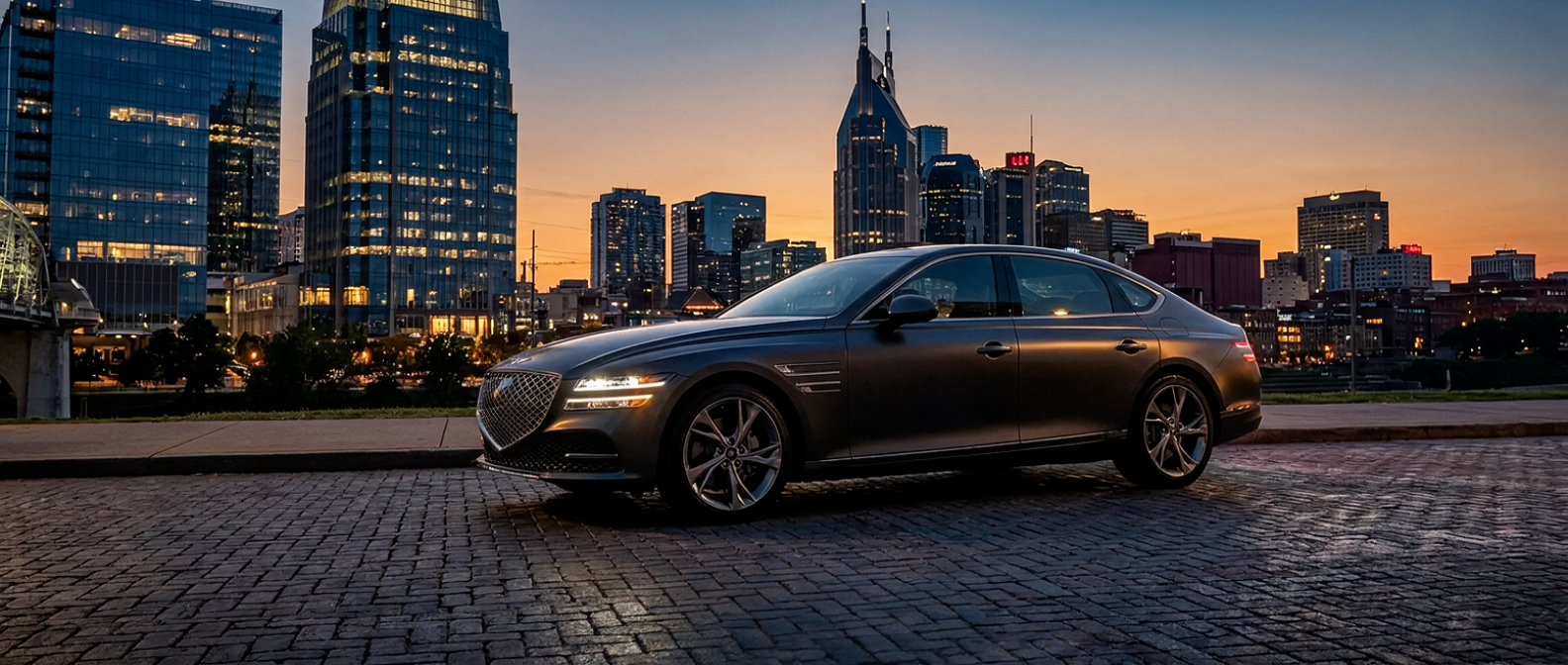
For 2026, these two cars have pulled apart more sharply than at any point in their histories. The choice between them isn't about styling preference or badge loyalty anymore. What it comes down to is powertrain, and the kind of driving experience that actually fits a life in Middle Tennessee.
- The 2026 Genesis G80 is a traditionally powered, AWD-standard midsize luxury sedan with a 300 hp turbocharged four-cylinder or a 375 hp twin-turbo V6.
- The 2026 Lexus ES has gone fully electrified: it's now a hybrid (ES 350h) or a full battery-electric (ES 350e, ES 500e). No gas-only engine remains.
- The ES 350h delivers an EPA-estimated 46 mpg combined (FWD); the G80 2.5T delivers EPA-estimated 20 city / 29 highway.
- The G80 offers more driver engagement and comes standard with AWD on every trim; the ES prioritizes serenity and exceptional rear-seat room.
- If you want conventional performance with AWD confidence, the G80 is your car. If fuel economy and a near-silent cabin define your commute, the ES 350h earns a serious look.
What's the Real Difference Between the G80 and the ES in 2026?
The short answer is that they're no longer the same kind of car. The Genesis G80 stays a conventionally powered sedan, turbocharged and AWD-standard, while the Lexus ES has reinvented itself for 2026 as an electrified-only model, offered as the sixth-generation hybrid ES 350h or one of two battery-electric variants. If you walked in expecting two similar midsize luxury sedans trading styling points, 2026 has made that framing obsolete.
Across the axes that matter most for Nashville buyers, here is how they stack up.
| Comparison Axis | 2026 Genesis G80 (2.5T) | 2026 Lexus ES 350h (FWD) |
|---|---|---|
| Powertrain | 2.5L turbocharged I-4, 300 hp | 2.5L hybrid, 244 hp combined |
| Drivetrain | AWD standard, all trims | FWD standard; AWD optional |
| EPA Fuel Economy | 20 city / 29 hwy (EPA-estimated) | 48 city / 44 hwy (EPA-estimated) |
| Rear Legroom | 38.7 inches | 40.7 inches |
| Trunk Space | 13.1 cu. ft. | 13.3 cu. ft. (ES 350h) |
| Rear Seat Folds? | Yes (pass-through) | No (pass-through only) |
| Base Tech | 27-inch OLED display, standard | 14-inch touchscreen, standard |
| IIHS Safety | 2026 Top Safety Pick+ | Not yet rated for 2026 |
| NHTSA Safety | 5-Star Overall | Not yet rated for 2026 |
Does the Powertrain Shift Change Everything?
For many Nashville buyers the answer is yes, because the Lexus ES 350h opens the new lineup as a compelling hybrid while the G80 holds the conventional line. The EPA rates it at 48 city / 44 highway for the FWD model, and 47 city / 42 highway with AWD. Numbers that stand alone in this segment. But it makes 244 system horsepower, and that's a real step down from the G80 2.5T's 300 horsepower and 311 lb-ft of torque available from just 1,650 rpm. On the on-ramps of I-65 South, where traffic compresses and lanes merge without ceremony, that low-end torque in the G80 has a feel the hybrid can't replicate.
The full-electric ES 350e and ES 500e are a separate conversation. On 19-inch wheels, the ES 350e delivers an EPA-estimated 307 miles of range and charges from 10 to 80 percent in roughly 28 minutes at 150 kW. Its dual-motor ES 500e sibling brings 338 horsepower and standard AWD. Our Genesis G70 gives you a sense of what the brand does when it prioritizes driver engagement in a smaller package, while the G80 occupies the composed, powerful middle ground the ES now vacates.
If you don't have home charging infrastructure and prefer the simplicity of a gas fill-up, that reality alone may settle the question. The hybrid ES 350h needs no plug; the full-electric models do, worth knowing before you fall for the range numbers.
Rear Seat, Cabin, and the Things You Actually Live With
The ES wins the rear-seat measurement outright, and it isn't close. At 40.7 inches of rear legroom in the new eighth-generation body (up 1.4 inches over the outgoing ES), it's genuinely spacious. Reviewers at Autoblog noted legroom "limousine-like" for the class. The G80 offers 38.7 inches, which is comfortable for most adults, but it's a measurable two inches shorter. If you regularly carry passengers in the back, that gap registers on longer drives.
The G80 answers with cabin technology. Its 27-inch OLED display combines the instrument cluster and infotainment into one continuous panel, and it comes standard on every trim rather than as a premium upgrade. The hardware is impressive enough to make the competition's screens feel dated. The ES 350h brings a 14-inch touchscreen that's clean and well-organized, though it carries about a third the visual presence.
Trunk space is essentially a draw, 13.1 cubic feet for the G80 against 13.3 for the ES 350h. Both offer a pass-through rather than a fully folding rear seat, though the G80's center console also connects to the trunk, useful for longer items. Neither is going to replace an SUV for cargo volume. Browse our current G80 inventory to see which trims are available on the lot.
Practical Ownership: Safety, AWD, and Nashville Conditions
Middle Tennessee doesn't get sustained winter weather, though it gets enough of it, a few ice events a year that catch the region's road infrastructure underprepared. When one of those mornings arrives, the G80's standard AWD on every single trim turns into a real advantage over the ES 350h's FWD-standard setup. AWD is available on the ES 350h (Lexus adds a rear-mounted 54 hp electric motor to create an on-demand system), but it's not the default, and you pay to add it. On our lot, that standard AWD is the detail that quietly closes a test drive once a buyer has crept through one Nashville ice morning.
Is the safety case settled for these two? For the G80 it is, verified and current. IIHS named the 2026 G80 a Top Safety Pick+ on vehicles built after June 2025, its top designation. NHTSA gave it a 5-Star Overall Safety Rating. The 2026 Lexus ES hasn't been rated yet by either body, which isn't a disqualifier but does mean the independent third-party confirmation isn't in hand for buyers who want it before signing.
| Feature | 2026 Genesis G80 | 2026 Lexus ES 350h |
|---|---|---|
| Pros | AWD standard, 300 hp, 27" OLED standard, IIHS Top Safety Pick+, NHTSA 5-Star | 46 mpg combined (EPA), exceptional rear legroom, hybrid simplicity, no-plug option |
| Cons | 20 mpg city (EPA), lower rear legroom vs. ES | FWD standard (AWD is optional), 244 hp, no current IIHS/NHTSA ratings |
So Which Sedan Should You Choose?
The right pick comes down to buyer profile, and both cars have a clear case. If you want conventional power and AWD that's standard rather than optional, the G80 makes the decision easy, while a buyer chasing efficiency and rear-seat space will find the ES 350h harder to ignore. What follows breaks it out by who you are.
Choose the G80 if: You want AWD confidence without paying extra for it, you prefer the feel of a 300 hp turbocharged engine with immediate torque, the standard 27-inch OLED display and IIHS Top Safety Pick+ matter to your decision, or you'd rather not navigate a new charging infrastructure. In the showroom, the G80 comes up against European sedans, and it tends to win when a buyer wants genuine rear-drive-tuned character with AWD practicality folded in, not as a compromise but as the actual engineering priority.
Choose the Lexus ES 350h if: Your priority is efficiency above all else and 46 mpg combined (EPA-estimated) changes the calculus of daily driving costs. The ES is also the right answer if your rear passengers are adults who will feel every one of those extra two inches of legroom over longer Tennessee drives.
Choose the Lexus ES 350e or ES 500e if: You have home charging or easy workplace access, and you want to step fully into battery-electric ownership in a composed, well-sorted luxury package with a familiar shape. A fully electric buy is a different decision from this comparison, and worth its own conversation.
The G80 is the stronger all-around sedan for Nashville conditions as they stand today, with AWD standard, performance on demand, verified safety credentials, and a technology interior that sets the standard for this segment. Browse our pre-owned inventory if a recent certified model fits your timeline, or consider the new lineup directly.
Frequently Asked Questions
Does the 2026 Lexus ES still come with a regular gas engine?
No. The 2026 Lexus ES lineup is fully electrified. Lexus offers it as the ES 350h hybrid (244 hp combined, EPA-estimated up to 46 mpg combined in FWD form), the ES 350e battery-electric (221 hp, EPA-estimated 307 miles of range on 19-inch wheels), and the dual-motor ES 500e (338 hp, standard AWD). The conventional V6 and base four-cylinder gas engines from previous generations are no longer available in the 2026 lineup.
Is the 2026 Genesis G80 available with rear-wheel drive?
No. Every 2026 Genesis G80 trim comes standard with all-wheel drive. There is no rear-wheel-drive option available in the current lineup. Both the 2.5T four-cylinder (300 hp) and the 3.5T twin-turbo V6 (375 hp) send power to all four wheels through an eight-speed automatic transmission.
