
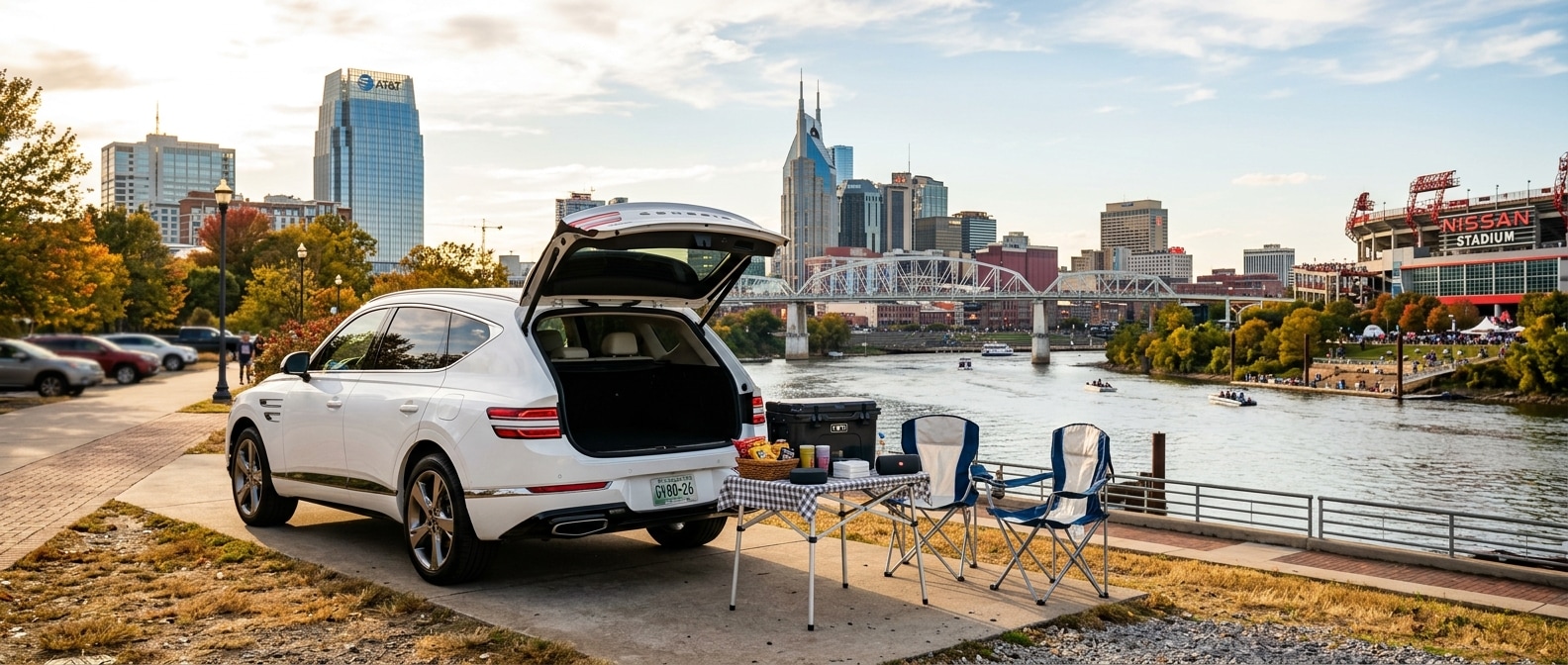
The official Nissan Stadium tailgating rule is blunt and non-negotiable. Your entire setup must fit in the space directly behind your vehicle, full stop. No spreading into the next spot, no blocking the lane. One constraint changes how you configure the GV80, and it's the constraint that actually plays to the vehicle's strengths in ways that are easy to overlook.
What does a contained setup actually take? Fold the second row flat, drop the cargo floor to its lower position, and you've got 71.7 cubic feet of level load space with the tailgate serving as your counter. Done right, the GV80's footprint contains a complete game-day setup (cooler, folding table, chairs, and a Bluetooth speaker) inside a single parking space, with room to move behind it.
The 2026 Genesis GV80 handles this more naturally than it might first appear, so let's walk through the configuration one step at a time.
What Do You Need Before You Start?
You need less than you'd expect, because the GV80 arrives at the lot with the flexibility already built in, so the prep that matters is knowing your trim and understanding how the seating configuration shapes your staging options before you ever load a cooler.
| Configuration | Cargo Behind 2nd Row (Seats Up) | Max Cargo (Rows Folded) | Third Row Available |
|---|---|---|---|
| 2-Row (2.5T RWD / AWD / Select) | 38.7 cu ft | 71.7 cu ft | No |
| 3-Row (Advanced / Prestige / Prestige Black) | 36.5 cu ft | 71.7 cu ft | Yes |
Both configurations reach the same 71.7-cubic-foot maximum. Genesis specifies that figure for the GV80 with all rear seats folded. Two-row owners fold one row, while three-row owners fold two. Either way, the cargo floor goes flat and level, which matters in a stadium lot where you're loading and unloading standing up in a tight space.
Browse our current GV80 inventory to confirm which configuration you're working with before game day.
Name the tradeoff plainly. The third-row option adds versatility for passenger hauling, but with all seven seats in use you're down to 11.6 cubic feet behind the third row. That's not a tailgate scenario. If you regularly carry a full group and tailgate gear on the same trip, the two-row trim keeps your options cleaner.
The Setup: Eight Steps for a Contained Nissan Stadium Tailgate
The official lots open four hours before kickoff, and that window is more than enough if you work it calmly, because a rushed setup in a single parking space is where people knock over coolers and clip the car behind them. A calm setup beats a scramble here.
1. Park with your tailgate oriented toward open space, not traffic.
Before you pull in, think about the exit lane. Since your setup must stay behind the vehicle, your tailgate direction locks in your working zone. Back in when you can, because backing in is a minor thing that smooths the whole sequence.
2. Lower the cargo floor to its bottom position.
The GV80's cargo area has a two-position floor, upper for everyday loads and lower for taller or bulkier items. Drop it to the lower position before you load anything, because a floor that sits lower gives you better clearance for a standing cooler and it'll keep taller items stable in transit.
3. Fold the second-row seats fully flat.
You'll find the release tabs in the cargo area, or use the buttons on the seatbacks themselves. The 40/20/40 split means you can fold the outer two-thirds and leave the center up as a temporary shelf. For a full tailgate, going all the way flat is the cleaner call. The seatbacks fold forward and lock level with the cargo floor. Genesis specifies 71.7 cubic feet in this configuration.
The GV70 is the GV80's compact sibling, and it doesn't match this cargo volume, which becomes clear when you're fitting a cooler, a table, and chairs side by side.
4. Load in reverse order of use.
Chairs go in first because they're needed last, after everything else is deployed. Folding table goes next, positioned toward the tailgate end so it slides out easily. Cooler goes in last, closest to the opening, at reach-in height when you're standing behind the bumper. Get this sequence wrong and you're unpacking and repacking in a crowded lot (not ideal).
5. Open the power tailgate and use the glass separately.
The GV80's power tailgate opens with a kick gesture under the bumper. Let it rise all the way. The rear glass panel pivots up independently and holds at 90 degrees. In early September in Nashville, where temperatures routinely sit in the mid-to-upper 80s with high humidity, that glass angled up gives you a partial shade canopy over the cargo opening. Use it. A small detail, but it pays off when you're standing at the cooler in direct sun.
6. Set your table parallel to the bumper, not perpendicular.
The stadium rule requires everything to stay within the footprint immediately behind your vehicle. A standard 6-foot folding table set perpendicular to the rear bumper pushes you into the adjacent space. Set it parallel instead, tight to the bumper. The GV80's rear overhang is modest, so the open tailgate plus a parallel table positions you squarely within your footprint. Most people don't think about this constraint until they're already set up wrong.
7. Run electronics from inside the cargo bay.
Stadium policy allows televisions and audio devices within and just behind your parking space. The GV80's interior 12V outlets and USB ports are your cleanest power source for a portable speaker or a tablet screen. Sitting a Bluetooth speaker in the open cargo bay with the tailgate up carries sound behind the vehicle, and there's no cord running across the asphalt. Keep the setup self-contained.
8. Clear everything 45 minutes after kickoff.
The last step catches people off guard. Nissan Stadium policy requires all tailgating to stop at kickoff and for lots to be cleared of activity within 45 minutes afterward. If you plan to watch from the lot, know that window precisely. The GV80's power tailgate closes with a button press, and packing down takes under five minutes if you've loaded in the right order.
Arriving at the East Bank: What the Drive Actually Looks Like
Nissan Stadium sits on the East Bank of the Cumberland River, across from downtown Nashville, and the approach is the part that tests your patience, since Interstate 24 runs close by and both the Shelby Avenue and James Robertson Parkway exits back up meaningfully as kickoff nears. Game-day traffic on the East Bank doesn't negotiate.
The GV80's available Electronically Controlled Suspension reads road surfaces ahead with a camera and adjusts damper response before each wheel reaches the irregularity. Genesis equips select trims with this system to absorb surface changes at speed. The East Bank approach streets give it plenty to work with. Our team's consistent observation is that Comfort mode on the GV80's drive mode selector handles the patchy surface conditions between the interstate exit and the stadium lots better than Sport mode does. Sport firms the chassis for a reason, and that reason isn't a stadium parking lot. Switch to Comfort for the crawl in.
The GV80's Highway Driving Assist 2 (which autonomously maintains lane centering and following distance on marked highways) earns its keep on I-24 during the slow-in. It won't eliminate stop-and-go, but it reduces the fatigue of holding position in a long queue.
If you're not tailgating and prefer downtown parking instead, the John Seigenthaler Pedestrian Bridge from First Avenue across the river is a genuine option, a direct walk to the stadium from the downtown side. But if the tailgate is the point, you want the East Bank lots and a pre-purchased pass. Official stadium lots require a Titans-issued pass, and the popular ones fill fast for marquee matchups.
Explore financing options for the GV80
A Quick-Reference Recap Before You Head Out
Print this or screenshot it before you leave the house, because the details that matter most are the ones easiest to forget when you're unloading at 10 a.m. with a cooler in your hands and a queue forming behind you.
- Cargo floor to lower position before loading
- Second-row (or both rows, in three-row trims) fully folded: 71.7 cubic feet, flat floor
- Load order: chairs first, table second, cooler last and closest to the opening
- Table parallel to the bumper (keeps the setup inside your space)
- Use rear glass independently for cooler access; full hatch for loading only
- No propane grills in official lots (charcoal or electric alternatives only)
- Lots open four hours before kickoff; all tailgating must cease at kickoff and be fully cleared within 45 minutes after
- Reserve your pass before game day (official lots sell out for prime games)
The GV80 isn't a fussy vehicle in practice. The cargo floor wipes clean, the flat load surface means nothing shifts in transit on the East Bank surface streets, and the power tailgate doesn't require ceremony. If you're going to be in the lots at Nissan Stadium on a Titans Sunday, this is a well-sorted way to do it.
Now you know exactly how.
Frequently Asked Questions
Can the 2026 Genesis GV80 fit a standard 6-foot folding table and four camp chairs when loaded for a tailgate?
Yes. With the second-row seats fully folded, Genesis specifies 71.7 cubic feet of maximum cargo volume in a flat-floor configuration. A 6-foot folding table stored flat (typically folding down to around 6 inches thick) fits lengthwise along one side of the cargo bay, with four camp chairs stacked beside it and a 40-quart cooler positioned closest to the tailgate opening. In three-row GV80 trims, both the second and third rows need to be folded to reach the same flat floor and maximum volume.
Are propane grills allowed in the Nissan Stadium tailgating lots?
No. The Tennessee Titans' official stadium policy does not permit propane grills in any of the Nissan Stadium lots. Charcoal is the standard alternative. The same policy prohibits tents staked into the ground (weight-based anchoring only), requires your entire setup to stay within the space directly behind your vehicle, and mandates that lots be cleared of tailgating activity within 45 minutes after kickoff.
