
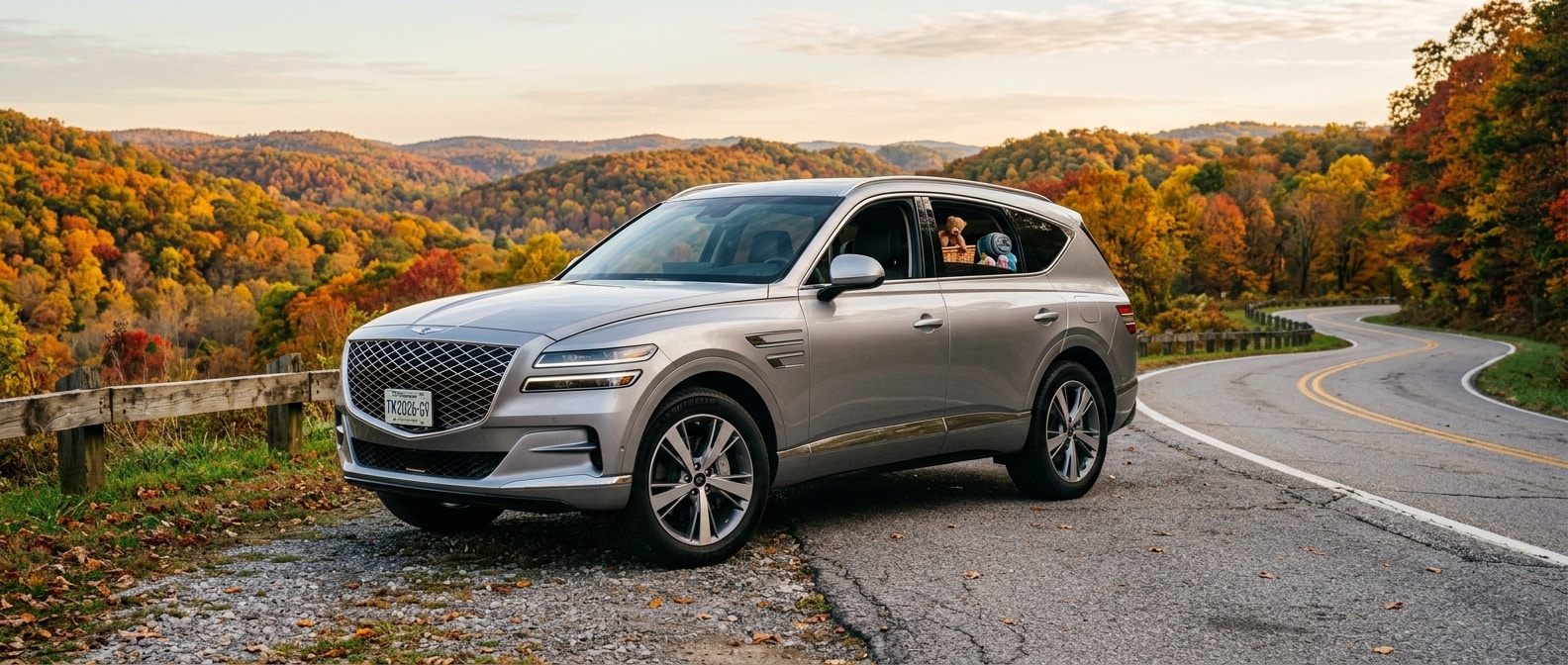
If you're standing in this segment right now, you've already trimmed a crowded field down to two vehicles worth taking seriously, and that's the right instinct. The 2026 Genesis GV80 and the 2026 Acura MDX are the two most distinct answers to the same question, and which one fits your family depends less on which spec sheet reads better and more on how you actually use a three-row SUV week to week.
When buyers come into our showroom at Genesis of South Nashville, the framing we give them is plain enough. The MDX is a more committed family hauler, available with three rows on every trim from the base model up, and it will never hand you a configuration puzzle. The GV80 is the more considered vehicle in materials and ride character, though its third-row availability is trim-dependent and its rear-row dimensions run smaller by a real margin. Both ask you to accept a trade-off. Neither one is a disqualifier.
How Does the Third Row Actually Work in Each SUV?
The short answer is that these two third rows aren't equivalent, and the path you take to reach each one differs by vehicle. That distinction matters more than it sounds for Nashville families who compare at-trim pricing instead of marketing sheets. One row comes standard. The other asks you to move up the lineup first.
The 2026 MDX arrives with three rows on all trims, full stop. Per Acura's own published specifications, cargo volume is 16.3 cubic feet behind the third row and 95 cubic feet at maximum with all rows folded. Its second row also carries a removable center seat, so you get a genuine choice between a seven-passenger bench and a six-passenger captain-chair layout that makes third-row boarding easier. Third-row legroom is 29.1 inches (per Acura's published figures), which is fair but snug for adults on a longer drive.
Over on the GV80, the story runs differently. The base 2026 GV80 is a five-seat two-row SUV, and third-row seating is standard only on the Advanced and Prestige trims (the 2.5T Advanced, 2.5T Prestige, 3.5T Advanced, and 3.5T Prestige, per Genesis's published lineup for 2026). When that third row is present, Genesis lists 11.6 cubic feet behind it and 71.7 cubic feet at maximum. Those are real numbers, and they're smaller than the MDX's. What the GV80 gives back is a power-folding third row on those upper trims (something the MDX doesn't offer in any configuration) and a cabin that, from sitting in both on our lot, carries better material quality at the seam and surface level. You notice it fast.
| Dimension / Feature | 2026 Genesis GV80 (3-row trims) | 2026 Acura MDX |
|---|---|---|
| Cargo behind 3rd row | 11.6 cu ft | 16.3 cu ft |
| Cargo behind 2nd row | 38.7 cu ft | 39.1 cu ft |
| Maximum cargo (all folded) | 71.7 cu ft | 95.0 cu ft |
| Third-row availability | Advanced + Prestige trims only | Standard on all trims |
| Power-folding 3rd row | Yes (qualifying trims) | No |
| 3rd-row legroom | Not published by Genesis | 29.1 in (Acura spec) |
| Overall length | 194.5 in | 198.4 in |
| Base engine output | 300 hp / 311 lb-ft (2.5T turbo I-4) | 290 hp / 267 lb-ft (3.5L V-6) |
| Available engine | 375 hp / 391 lb-ft (3.5T twin-turbo V-6) | 355 hp / 354 lb-ft (3.0T V-6, Type S) |
| AWD system | Standard AWD with Terrain Mode Select | Optional SH-AWD (torque-vectoring) |
| NHTSA overall rating | 5 stars | Not checked against 2026 MDX |
| IIHS designation | Top Safety Pick+ | Standard program |
| Standard infotainment | 27-inch integrated OLED display | Google Built-in touchscreen |
| Towing capacity | 6,000 lbs | 3,500 lbs (FWD); 5,000 lbs (SH-AWD) |
Towing is one detail the comparison pieces rarely state plainly. The GV80's 6,000-pound tow rating, per Genesis's published specs, sits well above the MDX's figure, which matters for Nashville families who keep a boat slip at Percy Priest or haul a trailer to a weekend soccer tournament in Bowling Green.
Which Platform Fits Nashville Families?
This is where the two engineering philosophies split, and where Middle Tennessee's driving conditions turn an abstract spec debate into something you can feel from the driver's seat. One system chases handling balance with active torque vectoring while the other chases ride isolation with a suspension that reads the road ahead. Both answers are valid. They just prioritize differently.
The Acura MDX's torque-vectoring approach:
- Uses SH-AWD (Super Handling All-Wheel Drive) to actively distribute power across all four wheels
- Improves cornering grip in both adverse weather and dry-road conditions
- Naturally aspirated 3.5-liter V-6 delivers power in a linear, predictable fashion for daily-driving confidence
On all trims, the GV80 runs a conventional AWD setup, paired with Terrain Mode Select and an Electronically Controlled Suspension with Road Preview on upper configurations. That suspension reads the surface ahead and adjusts damping before the wheels arrive, and the ride isolation that results shows itself on rough pavement. Its 300-hp 2.5-liter turbo four and 375-hp twin-turbo V-6 both carry more peak output than their MDX counterparts at equivalent points in each lineup.
Nashville's winter driving earns a specific mention here. January 2026 brought a sustained ice and freezing-rain event across Davidson County that TDOT documented in real time, with ice accumulation on overpasses, multiple incidents on I-65 south of the city, and conditions the Tennessee Emergency Management Agency classified as a prolonged hazardous event. Both the GV80's AWD and the MDX's SH-AWD beat rear- or front-wheel drive by a meaningful margin for the glaze-ice conditions Middle Tennessee produces. For slow-speed ice on a Bell Road on-ramp rather than a mountain road, the practical difference between the two systems is smaller than the marketing language on either side implies. What matters more there is how the suspension calibration keeps the car steady and the tires in contact, and that's where the GV80's Road Preview system does active work on rough or uneven surfaces.
For Nashville families mainly focused on carrying three children plus gear across a mix of daily I-65 commuting and weekend runs toward the Smokies, our team's read comes down to this. If you need a dependable three-row without a trim-level upgrade decision, and you want the most cargo volume in the segment, the MDX is structurally the right tool. If you're willing to step into Advanced or Prestige territory on the GV80 to reach that third row, what comes back to you is a cabin that feels more composed at highway speed, a 27-inch OLED display that our current GV80 inventory carries standard, and a power-folding mechanism with genuine daily utility when school pickup involves irregular load combinations, the kind you don't plan for.
The GV70 is worth a look too if your household needs three rows only occasionally rather than every day. The GV70 is a two-row SUV, so it won't solve the third-row question, but its smaller footprint is easier to manage in the Nashville parking structures off Broadway or in the tighter residential driveways that define a lot of the South Nashville neighborhoods we see in our zip codes.
| Term | What it actually means |
|---|---|
| SH-AWD | Acura's Super Handling All-Wheel Drive; uses torque vectoring to redistribute power between individual wheels, improving grip and handling balance independently of braking input |
| Longitudinal mounting | Engine oriented nose-to-tail, as in the GV80; typically found in rear- or all-wheel-drive platforms and generally allows more balanced weight distribution |
| Power-folding third row | A third-row bench that collapses flat via a button press rather than manual folding; standard on GV80 Advanced and Prestige trims |
| ECS with Road Preview | Genesis's Electronically Controlled Suspension system that uses forward-looking sensors to read road surface conditions and pre-adjusts damping before the wheels arrive at the disruption |
Value Your Trade-In Before You Decide
What This Means for Your Next Vehicle
The cleanest way to settle this comparison is to separate what you need every single day from what you want in a vehicle you'll keep for several years. The two SUVs answer those two questions differently. Daily necessity points one direction. Long-term satisfaction can point the other.
If three-row access is a daily requirement and you're not wedded to a specific trim level, the MDX's structure is the more forgiving entry, and its 95 cubic feet of maximum cargo volume is genuinely useful. The SH-AWD system on equipped trims handles Middle Tennessee's brief but real ice events with the active torque-vectoring precision it was built for. You don't have to upgrade to reach it.
If the third row is real but secondary, and you're already considering Advanced or Prestige territory, the GV80 earns its ground at that tier. NHTSA awarded the 2026 GV80 a five-star overall safety rating, and the IIHS named it a Top Safety Pick+, the organization's highest designation. Between the cabin's material quality, the 27-inch integrated OLED, the standard Bang and Olufsen audio on Prestige trims, and the power-folding third row, you end up with a vehicle that covers Nashville-to-Atlanta without the fatigue a less resolved cabin builds up over two hundred miles.
We'd encourage you to explore financing options before you settle on a configuration, since the trim-level decision on the GV80 specifically shapes what you're actually getting. Our team can walk you through exactly which trims include the third row, which include Road Preview, and how both vehicles sit in hand at the Advanced level, the natural comparison point where the decision usually gets made.
Let's be honest about the concession. If your family has three children who will actually occupy that third row on most trips, the MDX is the more purpose-built answer. The GV80 rewards the family whose third-row use is frequent but not constant, and who values the daily-driving experience across all the other hours the vehicle spends on Nashville roads.
Frequently Asked Questions
Does the 2026 Genesis GV80 come standard with a third row?
No. The 2026 GV80 is a five-seat, two-row SUV in its base and Select configurations. Third-row seating becomes standard on the Advanced and Prestige trims (both the 2.5T and 3.5T versions), and those trims also add a power-folding third row. If a seven-passenger GV80 is the goal, the trim level is part of the decision, not an add-on you weigh separately.
How does Nashville's winter weather affect the AWD decision between these two SUVs?
Both vehicles offer all-wheel drive, but the systems work differently. The MDX uses Acura's SH-AWD on equipped trims, an active torque-vectoring system that redistributes power between wheels independently, while the GV80 pairs a conventional AWD setup with Terrain Mode Select. For Middle Tennessee's typical winter conditions (which the Tennessee Department of Transportation documented in January 2026 as ice accumulation and freezing rain on major corridors including I-65 south of Nashville), both systems provide meaningful traction confidence over two-wheel drive. The more practical differentiator for most Nashville family buyers is the GV80's Electronically Controlled Suspension with Road Preview, which actively adjusts damping for road surface changes and helps keep the car stable on uneven or compromised pavement.
