
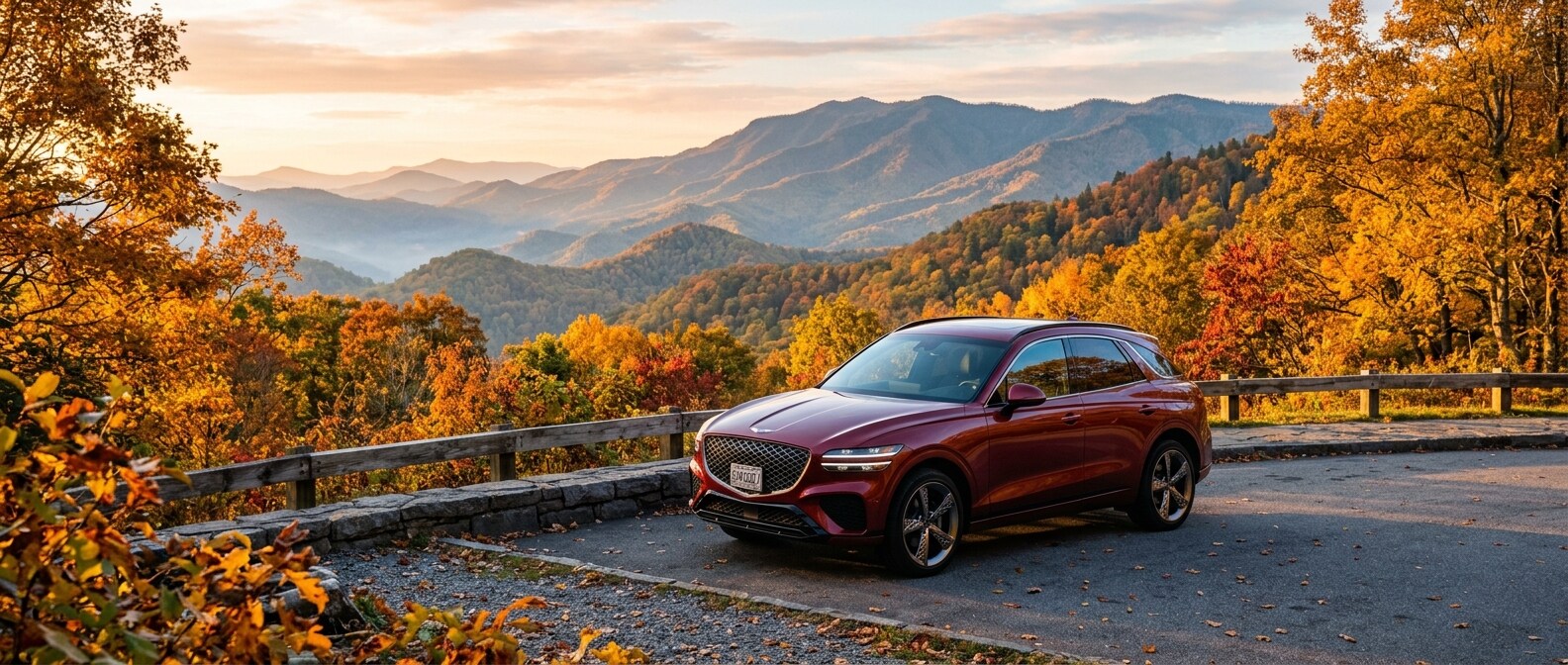
Nashville sits at roughly 600 feet above sea level. Newfound Gap Road, the main scenic crossing through Great Smoky Mountains National Park, crests at 5,048 feet. You climb nearly a mile of vertical in a single afternoon, and that swing changes three things your Genesis cares about. Air temperature, tire pressure, and sustained demand on the brakes. If you're planning a fall run east on I-40 toward Knoxville, up through Gatlinburg, or along the Foothills Parkway, the checklist below skips the generic car-care advice. We wrote it around what Tennessee's mountain terrain actually does to a turbocharged, AWD-equipped luxury vehicle.
One note up front, before anyone panics. If you're current on Genesis's scheduled maintenance program, you're probably in good shape already. None of this is about alarm, really. The point is knowing which five items are worth confirming before a long mountain drive rather than after.
The GV70 and GV80 are both well-suited to serious elevation change. Their AWD systems run rear-wheel-drive-biased by default, so they feel composed and balanced on the sweeping descents you find coming off Newfound Gap. That character needs no special preparation from you, though a few targeted checks are still worth the time before you head east.
The Pre-Trip Do's and Don'ts
| Do | Don't | |
|---|---|---|
| Tires | Check cold inflation pressure before you leave Nashville. Tire pressure drops roughly 1 PSI for every 10-degree Fahrenheit drop in temperature. At 5,000 feet on a fall morning, ambient temps can run 15 to 20 degrees cooler than back home. | Don't check pressure after highway driving. Road heat inflates the reading and hides underinflation. |
| Brakes | Have pad thickness and rotor condition confirmed. Clingmans Dome Road and the descent from Newfound Gap put sustained load on the brake system that routine Nashville driving simply doesn't. | Don't ride the brake pedal on long descents. Use the paddle shifters or Sport mode and let engine braking share the work. |
| Engine oil | Genesis specifies synthetic oil and filter changes every 8,000 miles. Verify you're within interval before the trip. A turbo engine working at elevation and under sustained load is doing more than it usually lets on. | Don't assume the drive is short enough to skip the check. Nashville to Gatlinburg and back approaches 350 miles before any scenic detours. |
| Cabin air filter | Replace if you're past 15,000 miles. Fall leaf debris and mountain pollen load a cabin filter quickly. A restricted filter makes the HVAC work harder for less result. | Don't skip it because the air smells fine. Restriction builds gradually. |
| Wiper fluid | Top off with a mix rated below freezing. At elevation in late October, you can meet frost before you reach Gatlinburg. | Don't use summer-formula fluid. It won't protect the pump or nozzles if it freezes overnight. |
Engine Braking: The One Technique That Changes the Whole Descent
Engine braking is the single technique that changes how a mountain descent treats your Genesis, and you'll want to use it consistently, because holding a lower gear spreads the stopping load across the drivetrain instead of piling every bit of it onto the pads and rotors the way steady pedal pressure does. On the return drop from Newfound Gap or the Foothills Parkway overlooks, select a lower gear manually with the paddle shifters on the GV70 or G70. Sustained downhill braking on a warm disc is how pads get glazed and rotors get warped. In a vehicle as composed and quiet as any Genesis sedan or SUV, you don't feel the stress accumulating until it already has.
Across the lineup, the turbocharged engines are well-matched to mountain grades. The GV70's 2.5T produces 300 horsepower; the 3.5T variant reaches 375. Both pull cleanly at altitude, and both run hotter under sustained load than naturally aspirated engines do. Check the oil and coolant before you leave.
Schedule a Pre-Trip Service Check
Five Items. Your Genesis Is Ready.
Five items cover the pre-trip checklist top to bottom, and our team can confirm every one of them in a single service visit, from cold tire pressure and oil within the 8,000-mile interval to brake fluid in good condition, a clear cabin filter, and wiper fluid rated for low temperatures. That accounts for the full list, nothing extra. By late October, we see cabin filters coming out of trip cars already packed with leaf grit and mountain pollen, well before the driver notices any drop in airflow.
The Foothills Parkway's western stretch and Newfound Gap Road are genuinely worth the drive. Fall foliage in the Smokies peaks from mid-October through early November at the lower elevations, and the NPS specifically recommends the Foothills Parkway for fall scenery with lighter crowds than the park's main corridor. The GV80 handles every grade and every overlook pull-off with the kind of composed, settled ride that makes the miles between Nashville and the mountains feel shorter than they are. Let our service team confirm it's ready before you point it east.
By the Genesis of South Nashville Team | September 2026
